Ecommerce
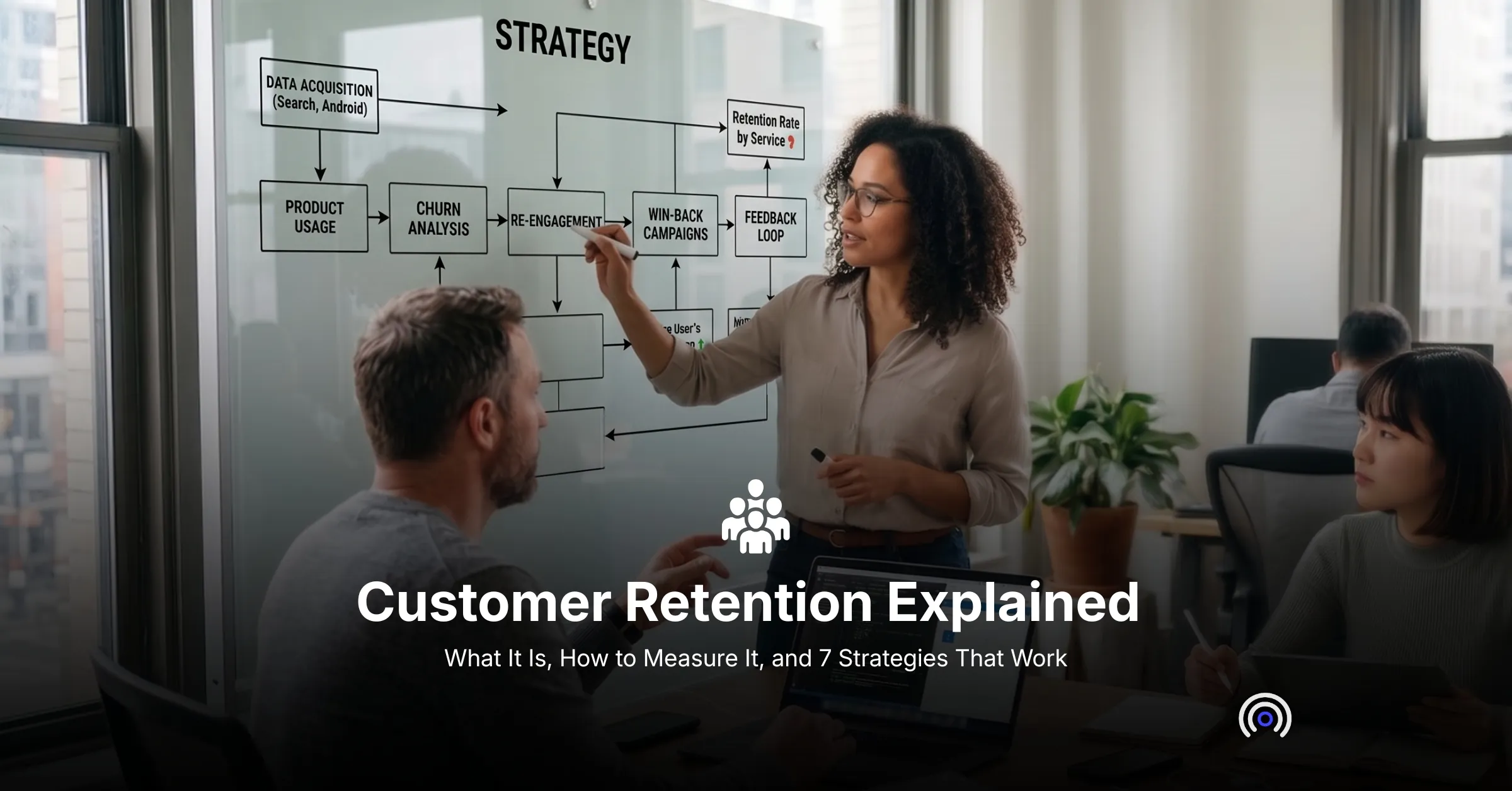
Customer Retention Explained: What It Is, How to Measure It, and 7 Strategies That Work (2026)

Every ecommerce brand wants more customers. Fewer realize that the most profitable customers are already in their database.
Consider this: existing customers spend 67% more per order than first-time buyers. They're 50% more likely to try new products. For the average order value breakdown — including the levers that lift AOV for both first-time and repeat buyers — that guide goes one layer deeper. And selling to them has a 60-70% success rate compared to just 5-20% for new prospects.
Yet most ecommerce brands still pour 80% of their marketing budget into acquisition — chasing new customers at $78-82 per head (up 233% since 2015) while their existing customers quietly churn.
This guide covers what customer retention actually is, how to measure it properly, where your industry benchmarks should sit, and seven strategies that move the needle in 2026.
What Is Customer Retention?
Customer retention is the practice of keeping existing customers buying from you over time. It's measured as the percentage of customers who make repeat purchases within a defined period — typically 90 days, 6 months, or a year.
High retention means customers come back. Low retention means they buy once and disappear.
The math is straightforward: if you start January with 1,000 customers, acquire 200 new ones, and end with 900 total customers, your retention rate is 70%. You kept 700 of your original 1,000.
Why does this matter so much? Because a 5% increase in retention can boost profits by 25-95%, according to research from Bain & Company. Small improvements compound dramatically over time.
The Economics: Why Retention Beats Acquisition
Acquisition gets the headlines. Retention drives the profits.
Here's why the math favors keeping customers over constantly finding new ones:
Customer acquisition costs have tripled since 2015. In competitive categories, you're paying $78-82 to acquire a customer while competing against 3.5 million other online stores for shrinking attention spans. Gen Z users decide whether to skip your ad in 1.3 seconds.
Meanwhile, your existing customers already trust you. They've validated your product quality, shipping speed, and overall experience. That trust translates directly into larger cart sizes and less price sensitivity.
The strategic question isn't "acquisition OR retention." It's "how do I balance both so acquisition costs don't eat my margins while I'm building a repeat customer base that compounds?" For the deeper breakdown of the acquisition side of that equation — including blended vs channel CAC, payback periods, and LTV:CAC ratios — see a related guide on customer acquisition cost.
Why Retention Measurement Breaks Down (The Attribution Problem)
Here's where most retention strategies go wrong: the data they're built on is incomplete.
You can't improve what you can't measure. And in 2026, most ecommerce brands are measuring retention with fragmented, inaccurate data.
The problem: modern privacy restrictions, cross-device journeys, and platform limitations mean 40-60% of customer touchpoints are invisible to standard tracking. When you don't know which channel acquired a customer, you can't measure which channels produce the highest-LTV buyers. When you can't connect a repeat purchase to its original acquisition source, your cohort analysis is built on gaps.
Ad platforms over-report conversions by 25-40% on average. Much of this inflation comes from claiming repeat customers as "new" acquisitions. Your retention rate looks lower than it actually is, and your acquisition costs look better than they actually are.
Signal Loss = Blind Personalization. Here's the part most brands miss: the same tracking gaps that break your retention metrics also break your retention strategies.
Consider Strategy #3 (Personalization) and Strategy #6 (Churn Prevention) below. Both depend on knowing who your customers are across every touchpoint. When your tracking can't connect sessions, you're not just miscounting — you're actively annoying customers with irrelevant data.
This is why brands that invest in signal enrichment — connecting customer identity across sessions, devices, and platforms — see their retention metrics shift dramatically. To review pricing for this use case — covering identity resolution, server-side tracking, and the infrastructure that makes retention measurement work — see the breakdown.Not because retention improved, but because they're finally measuring it accurately. And more importantly, their personalization and churn prevention efforts finally work because they're built on complete customer profiles.
7 Customer Retention Strategies That Work in 2026
1. Fix Your Post-Purchase Experience First
The window immediately after purchase is when customers decide whether they'll come back. Most brands neglect it entirely, defaulting to generic shipping confirmations and radio silence.
What works: proactive communication that reduces anxiety (shipping updates, delivery confirmation), personalized onboarding for complex products, and a follow-up that asks for feedback rather than pushing the next sale.
Brands that reach customers within the first 14 days of their initial order see up to 4x higher lifetime value from those cohorts.
2. Build Loyalty Programs That Create Real Switching Costs
Loyalty programs generate an average 5.2x ROI, with 83% of companies reporting positive returns. Members generate 12-18% more revenue annually than non-members.
But not all programs are equal. Points-based programs work when redemption is easy and rewards are meaningful. Paid membership tiers (like Amazon Prime) create psychological commitment that drives dramatically higher spending. The key is creating genuine value, not just gamification.
84% of consumers say they're more likely to stay loyal to brands that offer a loyalty program. The question isn't whether to have one — it's whether yours is compelling enough to change behavior.
3. Personalize Based on Behavior, Not Just Demographics
71% of customers expect personalized experiences. 76% get frustrated when brands fail to deliver. This isn't about using someone's first name in an email — it's about relevant recommendations, timely offers, and messaging that reflects their actual purchase history.
Customers receiving personalized experiences show 40% higher satisfaction scores and 2.1x higher lifetime values. The brands that lead in personalization generate 40% more revenue than competitors.
The barrier isn't technology — most ecommerce platforms have personalization capabilities. The barrier is data quality. Personalization built on fragmented customer profiles produces irrelevant recommendations that actively hurt retention.
4. Use Subscription or Replenishment Models Where They Fit
Annual subscriptions maintain 28% retention after one year versus just 3% for weekly billing. Monthly sits at 11%. The billing frequency you choose dramatically impacts whether customers stick around.
Chewy's Autoship program drives 82% of their net sales. For consumable products with predictable replenishment cycles, subscription models convert one-time buyers into recurring revenue automatically.
Not every product fits a subscription model. But if yours does, you're leaving retention gains on the table by not offering it.
5. Create Omnichannel Experiences That Actually Connect
Companies with strong omnichannel engagement retain 89% of their customers compared to just 33% for weak implementations. That's a 56-point gap.
Omnichannel doesn't mean "be everywhere." It means customer experiences should be consistent and connected regardless of where they interact with you — email, SMS, social, web, in-store. When a customer browses on mobile but purchases on desktop, your systems should recognize it's the same person.
This is where signal enrichment becomes critical. Without unified customer identity, you can't deliver omnichannel experiences — you're just running disconnected campaigns across multiple platforms.
Technical Note: Why Omnichannel Fails Without Identity Resolution
Consider a customer who browses your site on their personal phone during lunch, then purchases on their work laptop that evening. Without identity resolution connecting those sessions, here's what happens:
Your retargeting treats the phone session as an abandoned browser — so you spend ad dollars "acquiring" someone who already converted. Your email system shows them as a "new customer" on desktop, missing their browse history for personalization. Your attribution reports credit the desktop session as a cold acquisition, inflating your CAC and hiding the mobile touchpoint that actually started the journey.
Omnichannel retention requires knowing it's the same person across devices. Otherwise, you're paying to acquire customers you already own.
6. Implement Proactive Churn Prevention
By the time a customer has churned, winning them back costs significantly more than preventing the churn in the first place. Proactive outreach to at-risk customers delivers up to 14% retention lift — the highest impact of any single intervention.
The key is identifying churn risk before it happens: declining engagement, longer gaps between purchases, reduced email opens. RFM segmentation (Recency, Frequency, Monetary value) helps identify at-risk customers who have high historical value but declining recent activity.
Your "at-risk" segment — customers with high historical purchase frequency who've recently gone quiet — is your highest-ROI retention opportunity. They already trust your brand; something just interrupted their buying pattern.
7. Turn Satisfied Customers Into Referral Channels
Referred customers are 4x more likely to purchase and carry 16% higher lifetime value than customers acquired through other channels. They also demonstrate 2x higher repeat purchase rates.
Referral programs work because they leverage trust that already exists — recommendations from friends carry more weight than any ad. The customers you acquire through referral arrive pre-qualified and already warm.
Most referral programs underperform because they're hidden or the incentives are too small to motivate action. Make referral prominent post-purchase (when satisfaction is highest) and ensure the reward is meaningful to both the referrer and the new customer.
Measuring What Matters: Key Retention Metrics
Retention rate alone doesn't tell the full story. Here are the metrics that matter:
Customer Lifetime Value (LTV): Total revenue a customer generates over their relationship with your brand. Track by acquisition channel to identify which sources produce the highest-value customers.
Repeat Purchase Rate: Percentage of customers who make a second purchase within a defined window. Target more than 20% at 90 days for healthy ecommerce.
Purchase Frequency: How often customers buy. Increasing frequency by even one additional purchase per year compounds significantly across your customer base.
Churn Rate: The inverse of retention — what percentage of customers stop purchasing. For subscriptions, this is straightforward. For transactional ecommerce, define "churned" as no purchase within a reasonable window for your category.
Net Promoter Score (NPS): How likely customers are to recommend you. High NPS correlates with higher retention and referral rates.
The challenge: each of these metrics requires accurate customer identity across all touchpoints. If your tracking is fragmented, your retention metrics are built on incomplete data — and the strategies you build on them will underperform.
The Bottom Line
Customer retention isn't a "nice to have" sitting behind acquisition on your priority list. It's the foundation of sustainable profitability. For how retention fits alongside acquisition, AOV expansion, and channel diversification when scaling your store sustainably, that playbook ties the levers together.
The math is clear: retention costs 5-25x less than acquisition, repeat customers spend 67% more, and a 5% improvement in retention can boost profits by 25-95%. In a market where acquisition costs have tripled and attention spans have collapsed, the brands that win are those that keep customers coming back.
But retention strategies only work if they're built on accurate data. When 40-60% of customer journeys are invisible to standard tracking, your retention metrics are based on gaps. You can't personalize effectively. You can't identify at-risk customers before they churn. You can't measure which acquisition channels produce the highest-LTV buyers.
Signal enrichment closes these gaps by connecting customer identity across devices, sessions, and platforms — giving you the complete picture you need to retain customers profitably.
Start with the fundamentals: know your retention rate, benchmark it against your industry, and identify the biggest leaks in your post-purchase experience. Then build from there with loyalty programs, personalization, and proactive churn prevention.
The customers who will grow your business next year are already in your database. The question is whether you can keep them.
Get Started
Start Tracking Every Sale Today
Join 10+ e-commerce stores. Set up in 5 minutes, see results in days.