Your traffic is up. Conversion rates look healthy. But somehow, revenue isn't growing the way it should.
The culprit is often hiding in plain sight: your average order value.
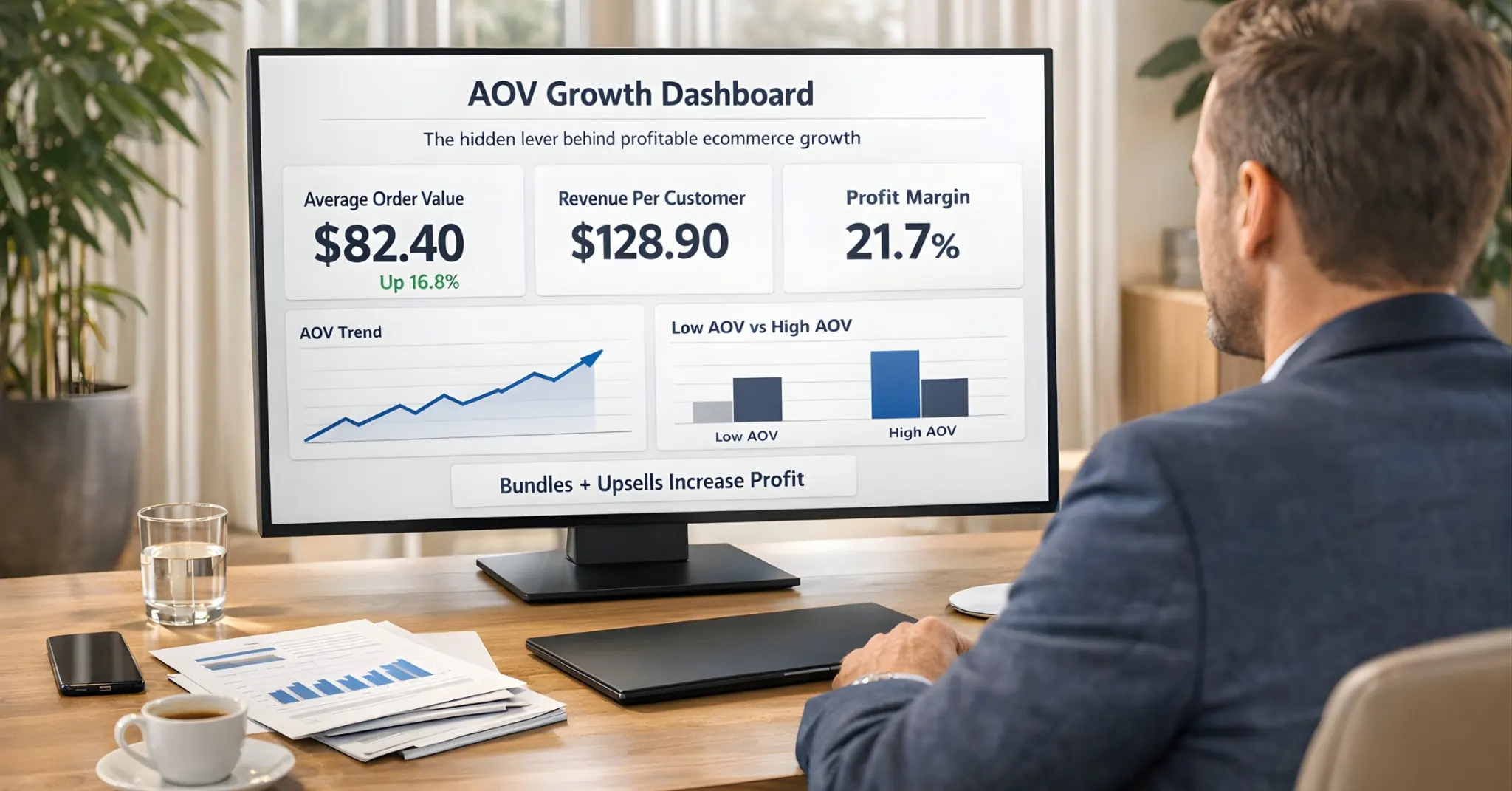
When customers spend more per transaction, you earn more from every ad dollar, every email, every visitor. AOV is one of the few metrics that improves profitability without requiring a single additional customer.
This guide breaks down what AOV means, why it matters in 2026, current benchmarks by industry, and the tactics that actually move the needle.
What Does AOV Stand For?
AOV stands for Average Order Value. It measures the average amount customers spend per transaction on your site.
The formula is straightforward:
If your store generated $50,000 from 500 orders last month, your AOV is $100.
That's it. No complexity. But this simple metric carries enormous weight for your business economics.
What AOV tells you:
How effectively your pricing, merchandising, and checkout experience encourage larger purchases
Whether your ad spend can absorb rising acquisition costs
How much room you have for free shipping thresholds and promotional offers
What AOV doesn't tell you:
Why customers bought what they bought
Whether those customers will return
If higher order values came at the expense of margins
AOV is powerful, but it's not the whole picture. A high AOV can mask problems like declining conversion rates or shrinking margins from heavy discounting.
2026 AOV Benchmarks: Where Do You Stand?
Knowing your AOV is step one. Knowing whether it's competitive is step two.
Global averages in 2026:
Metric | Benchmark |
|---|---|
Global ecommerce AOV | $145–$155 |
DTC brands | $60–$150 |
Desktop AOV | $120–$155 |
Mobile AOV | $85–$112 |
AOV by industry:
Industry | Average AOV |
|---|---|
Luxury & Jewelry | $350–$436 |
Home & Furniture | $200–$253 |
Fashion & Apparel | $90–$140 |
Beauty & Personal Care | $65–$80 |
Food & Beverage | $55–$75 |
Pet Supplies | $60–$75 |
The gap between industries reflects product pricing, purchase frequency, and buying behavior. A $70 AOV in beauty isn't a problem if customers reorder monthly. A $70 AOV in furniture signals a serious issue.
The mobile gap matters: Mobile drives over 60% of ecommerce traffic but consistently shows 25–35% lower AOV than desktop. This isn't a problem to solve with the same tactics — mobile shoppers behave differently and need simpler, faster optimization approaches.
Why AOV Matters More Than Ever in 2026
Three forces make AOV increasingly critical for ecommerce profitability:
1. Acquisition Costs Keep Rising
customer acquisition cost (CAC) has increased steadily as ad platforms become more competitive. When it costs more to acquire each customer, you need each transaction to generate more value.
The math is simple: If your CAC is $40 and your AOV is $80 with 40% margins, you're earning $32 per order — barely breaking even on acquisition. Raise AOV to $120, and that same margin delivers $48 per order. Suddenly, you're profitable from day one.
2. Traffic Isn't Free (or Unlimited)
Growing traffic requires either more ad spend or more content and SEO investment. Both cost time and money. AOV optimization works with traffic you already have — the visitors who've already arrived with purchase intent.
3. AOV Compounds Through Your Funnel
Higher AOV improves nearly every other metric:
ROAS increases because each conversion is worth more
Contribution margin improves because fixed costs (shipping, packaging, handling) spread across larger orders
Payback periods shorten because you recover CAC faster
Lookalike audiences improve because you're feeding platforms data from higher-value customers
A 10% lift in AOV doesn't just add 10% to revenue — it cascades through your entire business model. For the broader playbook on compounding growth, see growth tactics for online stores covering CAC, LTV, retention, and AOV working together.
The Modal Order: Where Real AOV Gains Hide
Here's a concept most AOV guides miss: modal order value.
Your AOV is an average, which means it's pulled in both directions by outliers. A handful of large orders can inflate your AOV while most customers actually spend much less.
Why the average can lie:
Example: If your AOV is $100, but your most common order is $45, your optimization target should be that $45 order — not the average.
To find your modal order value:
Export your order data for the past 90 days
Look at the distribution of order values
Identify the most frequent order size (your mode)
Focus AOV tactics on moving that typical customer to the next threshold
Incremental gains on the majority of orders almost always outperform chasing occasional big spenders.
6 Proven Tactics to Increase AOV
These strategies work because they add value for customers, not just revenue for you. The best AOV tactics make purchases feel more complete, more convenient, or more worthwhile.
1. Set Smart Free Shipping Thresholds
Free shipping thresholds remain one of the most reliable AOV levers. Research shows 58–80% of shoppers will add items to qualify for free shipping.
The formula: Set your threshold 15–25% above your current AOV. If your AOV is $80, test free shipping at $99.
Warning: Set it too high and you'll hurt conversion rates. Too low and you leave money on the table. Test incrementally.
The Profitability Box: When Free Shipping Actually Costs You
Free shipping isn't "free" — you're absorbing a cost. The question is whether the additional cart value covers it.
Pro Tip: If your shipping cost is $10 and your margin is 50%, you need an additional $20 in the cart to break even on the free shipping offer. If your threshold only pulls in an extra $10, you're actually losing profit despite the higher AOV.
2. Bundle Complementary Products
Bundles increase perceived value without requiring deep discounts. When customers see thoughtfully paired products, 72% of bundle interactions result in items added to cart.
What works:
"Complete the look" bundles in fashion
Starter kits for new customers
Replenishment bundles for consumables
Problem-solution bundles (e.g., skincare routines, workout sets)
What doesn't work: Random product groupings with arbitrary discounts. Bundles need to make sense for how customers actually use your products.
3. Time Upsells and Cross-Sells Correctly
The moment after a customer adds something to their cart is psychologically optimal for suggestions. They've committed to buying but haven't checked out yet.
High-performing placements:
In-cart product recommendations (10–25% conversion rates)
Post-add-to-cart modals with complementary items
Checkout-page additions for warranties, gift wrapping, or rush shipping
Post-purchase upsells (6–8% conversion rates with 5x higher click rates than standard emails)
Why post-purchase upsells are risk-free for conversion: One-click post-purchase upsells are now standard in 2026 — and they're uniquely valuable because they happen after payment is processed. The customer has already converted. The original transaction is complete. This means post-purchase offers can't hurt your conversion rate; they can only add incremental revenue to orders that already exist.
The rule: Upsells should extend the customer's intent, not interrupt it. If someone's buying a camera, suggest a memory card — not an unrelated product on sale.
4. Use Tiered Pricing and Volume Discounts
Buy 2, save 10%. Buy 3, save 15%." This structure works especially well for consumables and replenishables. For B2B-style volume buyers specifically, see a related guide on B2B marketing attribution — order economics and attribution behave differently when buyers procure in bulk.
The psychology is straightforward: customers feel they're getting a deal while you increase order size and lock in repeat purchases.
Implementation tip: Analyze your historical data to set optimal tiers. Don't guess at $50/$75/$100 — find the natural breakpoints in your order distribution.
5. Offer Buy Now, Pay Later (BNPL)
BNPL options like Klarna, Afterpay, and Shop Pay Installments reduce the psychological barrier to larger purchases. Vendor data suggests AOV increases of 30–50% when BNPL is available.
By 2026, BNPL transactions are projected to exceed $560 billion globally. If you're not offering installment options, you're likely losing larger orders to competitors who do.
6. Personalize Recommendations
Generic "customers also bought" sections underperform personalized suggestions based on browsing history, cart contents, or past purchases.
AI-powered personalization can deliver 15–30% AOV improvements for brands that implement it effectively. Even simple rule-based personalization (showing related products based on category or brand) outperforms random recommendations.
When AOV Optimization Backfires
Not every AOV increase is a win. Watch for these warning signs:
Conversion rate drops: If AOV rises 15% but conversion falls 20%, you've lost ground. The metric that actually matters is Revenue Per Visitor (RPV):
RPV=Conversion Rate×AOV\text{RPV} = \text{Conversion Rate} \times \text{AOV}RPV=Conversion Rate×AOV
RPV is often the more "truthful" metric for growth because it captures both sides of the equation. An AOV increase that comes at the expense of conversion rate will show up immediately in declining RPV — even if AOV itself looks better.
Example: Your AOV increases from $100 to $115 (+15%), but conversion drops from 3.0% to 2.4% (-20%).
Old RPV: 3.0% × $100 = $3.00 per visitor
New RPV: 2.4% × $115 = $2.76 per visitor
Result: You're making 8% less per visitor despite higher AOV
Return rates increase: Aggressive upsells and bundles can lead to buyer's remorse. Monitor return rates by product type and order value.
First-time customer AOV looks great, but they never return: High-pressure tactics might squeeze more from a single transaction while destroying lifetime value.
Heavy discounting inflates AOV but kills margins: A 20% AOV increase means nothing if you gave away 25% in discounts to get there.
The test: Ask whether your AOV gains come from customers feeling like they got more value — or from tactics that create friction, pressure, or regret.
AOV and Your Tracking Stack
AOV optimization only works when you can measure it accurately. This requires clean data across your entire funnel.
What to track:
AOV by acquisition channel (paid social vs. email vs. organic)
AOV by device (mobile vs. desktop)
AOV by customer segment (first-time vs. returning)
AOV by product category
AOV before and after specific tactics (bundles, thresholds, upsells)
If your business has a B2B segment alongside DTC, see a related guide on B2B attribution for how AOV and order-level reporting differ across longer, multi-stakeholder buying cycles.
The attribution connection: If your tracking only captures 40–60% of conversions (common with pixel-only setups), your AOV data is based on an incomplete and potentially skewed sample. Server-side tracking ensures you're measuring actual order values from all customers — not just those your pixel can see.
Quick Wins: Improve Your AOV This Week
Check your current AOV against industry benchmarks — know where you stand
Find your modal order value — identify what typical customers actually spend
Test a free shipping threshold 15–25% above your current AOV
Add one relevant cross-sell to your cart page for your top-selling product
Segment AOV by device — if mobile is significantly lower, prioritize mobile-specific optimization
The Bottom Line
AOV is deceptively simple: total revenue divided by total orders. But that simplicity masks its power.
When acquisition costs rise and traffic gets harder to scale, AOV becomes the most efficient lever available. Every dollar added to the average order drops straight to your bottom line — no additional ad spend, no new customers required.
The brands winning in 2026 aren't just optimizing conversion rates. They're building AOV into every touchpoint: product pages, cart experiences, checkout flows, and post-purchase sequences. For brands evaluating the operational investment behind tracking and attribution that supports AOV growth, see pricing options.
Start with the fundamentals. Know your benchmarks. Find your modal order. Test one tactic at a time. And always measure AOV alongside conversion and margins — because a higher order value only matters if it's profitable.
Get Started
Start Tracking Every Sale Today
Join 1,389+ e-commerce stores. Set up in 5 minutes, see results in days.