Your B2B marketing report says the webinar drove the deal. Your sales team says it was the trade show. Google Analytics credits the branded search. Meanwhile, the CFO is asking why pipeline is down despite record ad spend.
Sound familiar?
This is the attribution problem — and in B2B, it's particularly painful. Unlike ecommerce where someone clicks an ad and buys a shirt, B2B deals involve multiple decision-makers, six-to-twelve month sales cycles, and dozens of touchpoints that span both digital and offline channels.
The stakes are high: misattribute your marketing, and you'll cut the channels that actually work while doubling down on the ones that just look good in reports.
This guide breaks down how B2B attribution actually works, why most teams get it wrong, and what to do about it in 2026.
What Is B2B Marketing Attribution?
B2B marketing attribution is the process of connecting your marketing activities to revenue outcomes. It answers a deceptively simple question: which marketing efforts actually contributed to this closed deal? For the broader system view across sales, RevOps, and CRM data, see a related guide on B2B attribution.
The challenge is that B2B buying journeys are anything but simple.
A typical B2B buyer in 2026 interacts with your brand dozens of times before converting. That's not just ad impressions — that's meaningful touchpoints: LinkedIn posts, blog articles, webinars, email sequences, sales calls, G2 reviews, trade show conversations, and more.
Attribution models are the frameworks that decide how to distribute credit across those touchpoints. Some models give all credit to a single interaction. Others spread it across the entire journey. The model you choose fundamentally shapes how you interpret your marketing performance — and where you invest your budget.
The Problem With Single-Touch Attribution
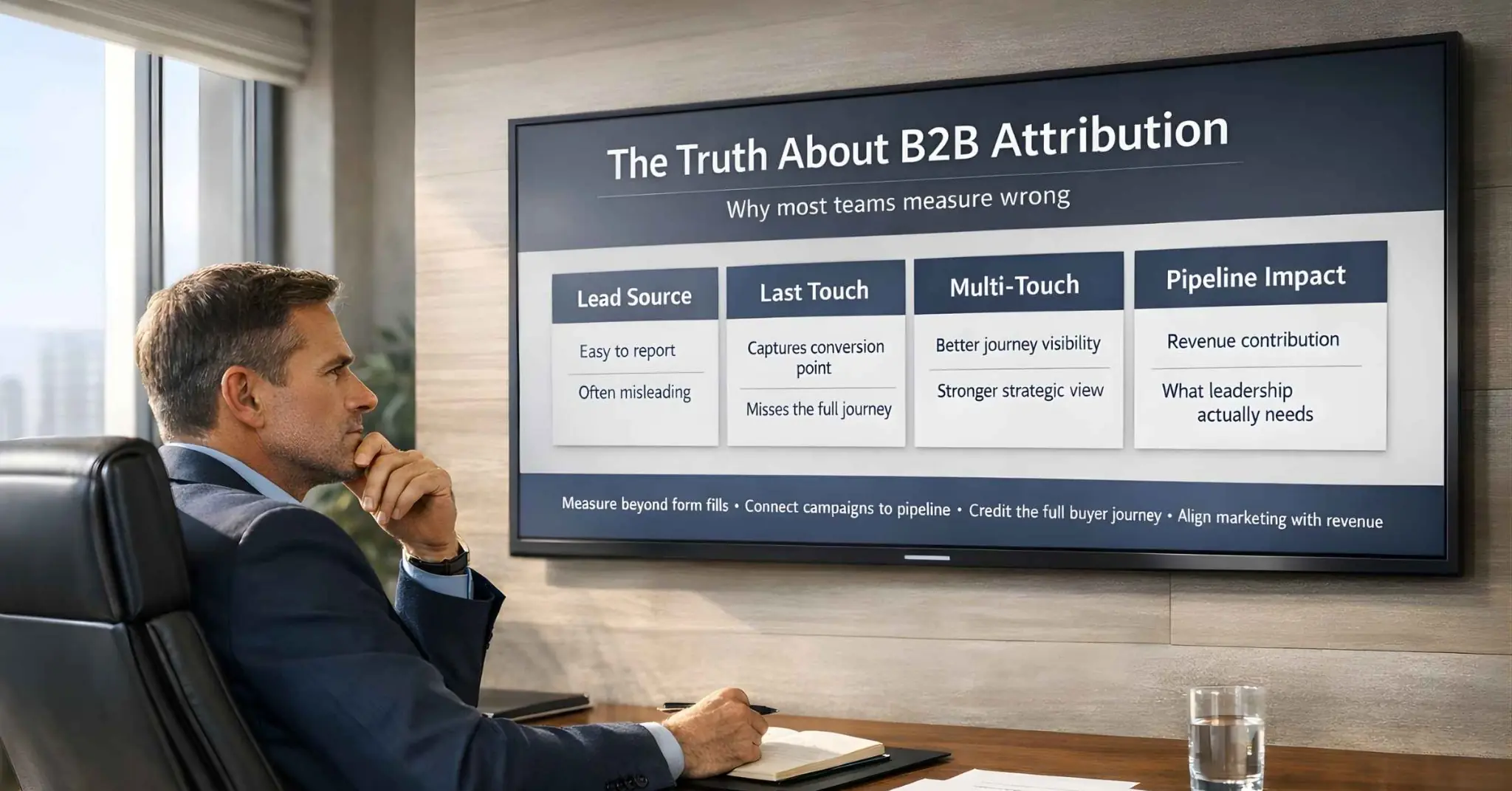
Here's a sobering reality: most B2B marketing teams still rely on last-touch attribution in 2026. That means the majority of B2B marketers are giving 100% of the credit to the final touchpoint before conversion — and ignoring everything that came before.
This is like giving the closing pitcher all the credit for winning a baseball game while ignoring the seven innings the starter pitched.
Why last-touch persists:
It's simple to implement
It's the default in most analytics tools
It produces clean, easy-to-understand reports
Why it fails in B2B:
It ignores the months of nurturing that warmed the prospect
It over-credits bottom-funnel activities (demo requests, pricing pages)
It under-credits top-funnel investments (content, brand, awareness)
It gives sales credit for deals that marketing actually influenced
First-touch attribution has the opposite problem: it credits the first interaction and ignores everything after. Great for understanding awareness channels, terrible for understanding what actually closes deals.
Single-touch models, by definition, ignore the vast majority of the buyer journey. In a world where B2B purchases involve multiple decision-makers and months of consideration, that's a lot of blind spots.
Multi-Touch Attribution Models: The 2026 Landscape
Multi-touch attribution (MTA) distributes credit across multiple touchpoints, giving you a fuller picture of what's working. Here are the models B2B teams actually use:
How Credit Gets Distributed: U-Shaped vs. W-Shaped
Linear Attribution
Every touchpoint gets equal credit. If a deal touched five marketing channels, each gets 20%.
Best for: Teams new to multi-touch who want a simple improvement over single-touch.
Limitation: It treats a casual blog visit the same as a demo request. Not all touchpoints are equal.
Time-Decay Attribution
Touchpoints closer to conversion get more credit. The logic: recent interactions have fresher influence on the buying decision.
Best for: Shorter B2B sales cycles where recency matters more than initial discovery.
Limitation: Can undervalue the content and campaigns that first brought the prospect into your orbit.
Position-Based (U-Shaped) Attribution
Gives 40% credit to the first touch, 40% to the last touch, and distributes the remaining 20% across everything in between.
Best for: Lead generation businesses where both awareness and conversion moments matter most.
Limitation: Arbitrary weighting that may not reflect your actual buying journey.
W-Shaped Attribution
Assigns 30% to first touch, 30% to lead creation, 30% to opportunity creation, and 10% distributed across other touchpoints.
Best for: B2B companies with defined funnel stages and clear sales handoffs. This model recognizes three critical inflection points rather than just two.
Limitation: Requires clean CRM data with accurate stage tracking.
Data-Driven (Algorithmic) Attribution
Uses machine learning to analyze your historical data and assign credit based on which touchpoints actually correlate with conversions.
Best for: Organizations with sufficient conversion volume and data maturity to train accurate models.
Limitation: Requires significant data; can be a black box that's hard to explain to stakeholders.
Account-Based Attribution: The B2B Imperative
Here's something most attribution guides miss: B2B deals aren't made by individuals — they're made by buying committees.
A single opportunity might involve:
A marketing manager who discovered you through content
A director who attended your webinar
A VP who talked to your sales rep at a conference
A CFO who reviewed your pricing page
The Aggregation Logic: How Individual Touches Become One Deal
Traditional attribution tracks individuals. But in B2B, you need to track accounts — rolling up all the touchpoints from everyone involved in the buying decision.
Account-based attribution answers questions like:
Which channels are reaching the right accounts?
How many stakeholders are we engaging before deals close?
Which content resonates with decision-makers vs. influencers?
The reality is that most B2B marketers struggle to connect multiple stakeholders to opportunities. If you're not doing account-level attribution, you're missing the full picture.
The Dark Funnel Problem
Not every touchpoint can be tracked. The "dark funnel" includes:
Private conversations: Slack messages, email forwards, word-of-mouth
Social browsing: LinkedIn lurking without clicking
Offline interactions: Events, phone calls, in-person meetings
Untracked referrals: Someone recommends you but doesn't use a trackable link
A significant portion of conversions have incomplete attribution data. The best response isn't to pretend these touchpoints don't exist — it's to complement your attribution data with other signals.
The Attribution Paradox: When Software and Customers Disagree
This is why self-reported attribution matters. When you ask "How did you hear about us?" you're capturing the influence that software can't see. The most accurate picture combines both:
Software-tracked data: What they clicked, when, how often
Self-reported data: What actually made them aware of you
Practical approaches:
Post-demo surveys asking "How did you hear about us?"
Self-reported attribution fields on forms
Sales call notes documenting offline mentions
Brand tracking studies to measure awareness
Attribution data tells you what you can measure. Qualitative research fills in what you can't.
Building Your B2B Attribution System
Attribution isn't a tool you install — it's a system you build. Here's a practical framework:
Step 1: Define Your Conversion Points
Map what counts as a conversion at each stage:
Awareness: Website visit, content engagement, social interaction
Consideration: Content download, webinar registration, pricing page visit
Decision: Demo request, sales meeting, proposal sent
Closed-Won: Revenue (the ultimate attribution target)
Step 2: Unify Your Data Sources
B2B attribution requires connecting:
CRM data (Salesforce, HubSpot) for deal stages and revenue
Marketing automation for email, forms, and campaign tracking
Ad platforms for paid media touchpoints
Web analytics for site behavior
Event/offline tracking for trade shows, calls, and meetings
The biggest blocker for most teams is data fragmentation. Your attribution is only as good as your data hygiene.
Step 3: Choose Your Model(s)
Most mature B2B teams use multiple models in parallel:
W-shaped for pipeline attribution
First-touch for understanding awareness channels
Last-touch for understanding conversion triggers
Compare models side-by-side. If they tell wildly different stories, investigate why.
Step 4: Connect to Revenue
Attribution should ultimately connect to closed-won revenue, not just leads or MQLs.A channel that generates lots of leads but no revenue is a problem, not a success. The same revenue-first principle drives ecommerce growth strategies — different motion, identical logic.
This requires integrating your attribution data with your CRM's opportunity and revenue data — and being willing to wait through your full sales cycle to see results.
Common Attribution Mistakes (And How to Avoid Them)
Mistake #1: Ignoring offline touchpoints
Trade shows, sales calls, and direct mail still matter in B2B. If your attribution only tracks digital, you're missing a significant chunk of influence.
Fix: Implement CRM tracking for offline interactions with consistent campaign tags.
Mistake #2: Attribution tunnel vision
Making dramatic budget cuts based solely on attributed performance without considering brand awareness, competitive positioning, and long-term value.
Fix: Balance attribution insights with brand studies, market share analysis, and qualitative feedback.
Mistake #3: Chasing perfect attribution
Spending months building an elaborate attribution system instead of taking action on imperfect-but-useful data.
Fix: Start with a simple multi-touch model, learn from it, and iterate. Perfect attribution doesn't exist.
Mistake #4: Measuring leads instead of revenue
Optimizing for MQLs when what actually matters is pipeline and closed-won deals.
Fix: Extend your attribution window to capture the full sales cycle, and weight your reporting toward revenue outcomes. The DTC parallel — focusing on order value rather than session counts — is covered in a related guide on average order value.
Attribution and Your Tracking Stack
Attribution data is only as accurate as your tracking. In 2026, privacy changes have made this harder:
Third-party cookies are declining across all browsers
iOS restrictions limit mobile tracking
Ad blockers prevent pixels from firing on a significant portion of traffic
Server-side tracking has become essential for maintaining attribution accuracy. Instead of relying on browser-based pixels that can be blocked, server-side tracking captures conversion data directly — ensuring your attribution models are working with complete information.
Without accurate tracking, you're building attribution models on a foundation of incomplete data. The insights you extract will be skewed toward the conversions you can track, not the full picture. To see how server-side tracking and account-level attribution work in your stack, schedule a walkthrough.
Quick Wins: Improve Your Attribution This Week
Audit your current model. What are you using? Last-touch? First-touch? Know your baseline.
Check your data connections. Is your CRM connected to your marketing automation? Are offline touchpoints being logged?
Run a model comparison. Apply different attribution models to the same data set and see how the story changes.
Add a self-reported field. "How did you hear about us?" on your demo form captures dark funnel signals.
Extend your attribution window. If your sales cycle is 6 months, a 30-day attribution window is missing most of the journey.
The Bottom Line
B2B marketing attribution is hard — but measuring wrong is worse than not measuring at all. When you credit the wrong channels, you waste budget, miss opportunities, and lose credibility with your executive team.
The goal isn't perfect attribution. It's better attribution — moving from single-touch guesswork to multi-touch insight, from individual tracking to account-level understanding, and from lead counting to revenue connection.
Start where you are. Use the data you have. Improve from there.
Because in B2B, the teams that understand what actually drives revenue will always outperform those that don't.
Get Started
Start Tracking Every Sale Today
Join 1,389+ e-commerce stores. Set up in 5 minutes, see results in days.