You followed the "best practices." Broad targeting. Advantage+ campaigns. Fresh creative every week.
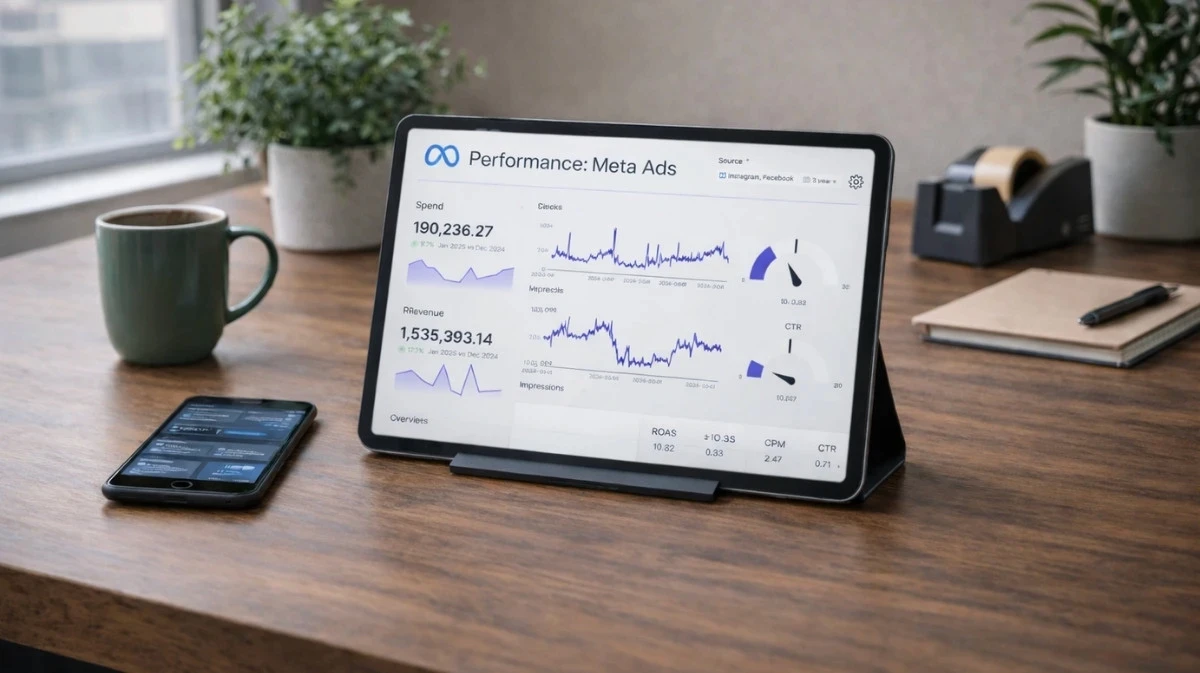
CPMs still rose. ROAS declined. And when you checked your actual revenue against Meta's reported numbers, the gap was $12K.
The problem isn't your strategy. It's that most optimization advice ignores what actually drives Meta's algorithm in 2026.
Facebook optimization in 2026 isn't about tactics anymore. It's about systems.
Meta's Andromeda algorithm update changed how ads are delivered. The platform now rewards accounts with clean data, diverse creative, and consistent conversion signals. It punishes accounts with poor tracking, repetitive ads, and fragmented campaign structures.
The brands winning on Meta aren't running secret strategies. They're running an optimization loop that feeds the algorithm what it needs — and measuring results against real revenue, not platform metrics.
This guide shows you how that loop works.
The 2026 Optimization Loop
Forget linear "step-by-step" guides. Meta optimization is cyclical — each element feeds the next:
The loop:
Data Quality → Clean tracking feeds better signals to Meta
Algorithm Learning → Better signals improve targeting and delivery
Creative Testing → Optimized delivery reveals winning creative faster
Performance Analysis → Accurate measurement identifies what's actually working
Back to Data → Insights improve tracking and audience signals
Break any link, and the whole system underperforms.
Step 1: Data Quality — The Foundation Meta Demands
In 2026, Meta's algorithm is only as smart as the data you feed it. Poor data = poor optimization.
What "Data Quality" Actually Means
Signal | Impact on Algorithm | How to Improve |
|---|---|---|
Event Match Quality (EMQ) | Determines if conversions match to users | Server-side tracking, send hashed email |
Conversion Volume | Enables learning phase exit (50/week minimum) | Consolidate ad sets, increase budget |
Signal Consistency | Prevents learning resets | Avoid frequent campaign edits |
Audience Data | Improves lookalike quality | Upload clean customer lists, exclude past buyers |
The EMQ Threshold
Meta's algorithm struggles with EMQ below 6.0. At that level, it can't reliably connect conversions to the ads that drove them — so it guesses.
Target benchmarks:
Purchase events: 8.5+
AddToCart events: 7.5+
ViewContent events: 6.5+
If your EMQ is lower, fix tracking before optimizing anything else. You're making decisions based on incomplete data.
2026 Reality: Browser-based pixels now miss ~35% of conversions due to ad blockers, iOS restrictions, and GPC headers. Server-side tracking (Conversions API) isn't optional anymore — it's required for accurate optimization. To walk through the setup with the team on an account similar to yours, that walkthrough covers EMQ, CAPI, and signal enrichment end-to-end.
Step 2: Algorithm Learning — Working With Advantage+
Meta wants you to use Advantage+ campaigns. They work — but only when you understand how the algorithm learns.
🔍 Andromeda Signal Weighting
Under Meta's Andromeda update, the algorithm places 3x more weight on server-side "Purchase" signals than it does on browser-side "ViewContent" signals. This means your conversion data matters exponentially more than engagement data.
If your server-side tracking is down or misconfigured, your optimization is essentially blindfolded — Meta is making decisions based on the weakest signals in your funnel.
What Advantage+ Actually Does
Advantage+ Shopping Campaigns (ASC) consolidate targeting, placements, and budget allocation into one AI-driven system. You provide creative and conversion signals. Meta handles delivery.
The catch: ASC optimizes for what you tell it to optimize for. If your tracking is broken, it optimizes for garbage data.
The Learning Phase Problem
Every ad set needs 50 conversions per week to exit the learning phase. During learning, performance is volatile and costs are higher.
Common mistakes that extend learning:
Too many ad sets (budget spread too thin)
Frequent edits (resets the learning)
Low conversion volume events (optimizing for AddToCart when you should optimize for Purchase)
The fix: Consolidate. Fewer ad sets with larger budgets learn faster than many ad sets with small budgets. For the budget-allocation layer that sits on top of consolidation logic, see a related guide on AI ad budget optimization.
Audience Suggestions vs. Broad
In 2026, Advantage+ Audience lets you provide "suggestions" rather than hard targeting constraints. Meta starts with your suggestions, then expands to find better prospects.
Best practice: Provide audience suggestions (lookalikes, customer lists) but let Meta expand. Hard constraints limit the algorithm's ability to find your best customers.
Step 3: Creative Testing — Diversity Over Volume
Meta's Andromeda update introduced two new metrics that reveal what the algorithm wants:
Creative Fatigue: How tired your audience is of seeing your ads
Creative Similarity: How repetitive your creative library is
High similarity = higher CPMs. The algorithm penalizes accounts with repetitive content because it has nothing new to test.
The Creative Diversity Requirement
In 2026, creative diversity matters more than creative volume. Ten variations of the same concept won't help. Three genuinely different concepts will.
What "different" means:
Different hooks (first 3 seconds)
Different formats (static vs. video vs. carousel)
Different angles (benefit-focused vs. problem-focused vs. social proof)
The Authentic Content Advantage
Meta's algorithm now favors content that looks native — like something a friend would post, not something a brand created.
What's winning in 2026:
UGC-style video (vertical, raw, unpolished)
Boosted organic posts (real post IDs outperform uploaded ads)
Founder/team content (real humans, not stock photos)
What's losing:
Overly polished brand content
AI-generated imagery (users recognize it and disengage)
Static ads with heavy text overlays
The Testing Framework
Test hooks first — The first 3 seconds determine if people watch
Test formats second — Video vs. static vs. carousel for the winning hook
Test angles third — Different messaging for the winning format
Graduate winners to evergreen — Only proven performers get long-term budget
Budget rule: Each creative needs enough spend to reach statistical significance. At low budgets ($10-20/day), test 2-3 creatives max. At higher budgets ($1,000+/day), test up to 6.
Step 4: Performance Analysis — Beyond Platform Metrics
Meta's dashboard tells you what Meta thinks happened. Your bank account tells you what actually happened. They're not the same.
The MER Reality Check
MER=Total Revenue (Shopify/Bank)Total Ad Spend (All Platforms)MER = \frac{\text{Total Revenue (Shopify/Bank)}}{\text{Total Ad Spend (All Platforms)}}MER=Total Ad Spend (All Platforms)Total Revenue (Shopify/Bank)
MER doesn't care about attribution. It tells you: for every dollar spent on marketing, how much real revenue came back?
When Meta ROAS looks great but MER is declining:
Meta is over-reporting conversions
You're cannibalizing organic sales
Attribution windows are inflating results
Trust MER over platform ROAS. To validate whether your platform-reported ROAS is causal or correlational, see a related guide on meta conversion lift tests.
Weekly Reconciliation
Every week, compare:
Metric | Meta Reports | Your Store | Gap |
|---|---|---|---|
Conversions | 200 | 147 | 53 over-reported |
Revenue | $40,000 | $29,400 | $10,600 phantom |
ROAS | 4.0x | 2.9x | 28% inflated |
If Meta consistently over-reports by 25-30%, mentally discount all Meta metrics by that amount when making decisions.
The Metrics That Matter
Metric | What It Tells You | Target |
|---|---|---|
MER | Overall marketing efficiency | 3.0-5.0x for healthy profitability |
nCAC | Cost to acquire new customers | Varies by industry, track trend |
New Customer % | Growth vs. retention ratio | 60%+ for scaling accounts |
EMQ | Data quality feeding algorithm | 8.0+ for conversion events |
Creative Fatigue | When to refresh creative | Act before CPMs rise significantly |
Step 5: Closing the Loop — Feed Learnings Back
The final step connects back to the beginning. What you learn from performance analysis should improve your data quality and creative strategy.
Converting Insights to Action
If MER is declining but Meta ROAS looks stable: → Your tracking has gaps. Audit EMQ and implement server-side tracking.
If CPMs are rising across all campaigns: → Creative fatigue. Check Creative Similarity score. Add genuinely different concepts.
If new customer % is dropping: → ASC is targeting existing customers. Upload customer exclusion lists and verify they're matching.
If learning phase never exits: → Consolidate ad sets. Increase budget per ad set. Optimize for Purchase, not micro-conversions.
The Feedback Signals
Send richer data back to Meta to improve future optimization:
Customer lists — Upload purchasers monthly to improve lookalikes and exclusions
Value signals — Send purchase values, not just purchase counts
Quality signals — If you track lead quality in your CRM, send qualified leads back via CAPI
The more Meta knows about your best customers, the better it finds more of them.
The Bottom Line
Meta optimization in 2026 isn't about finding the right tactics. It's about running a system that feeds the algorithm clean data, tests diverse creative, measures against real revenue, and improves based on what you learn.
The loop in practice:
Fix your tracking first — EMQ above 6.0, server-side implemented
Consolidate campaigns — Fewer ad sets, larger budgets, faster learning
Diversify creative — Different concepts, not just variations
Measure against reality — MER and store data, not just Meta's dashboard
Feed learnings back — Better data, better audiences, better creative
Once your loop is tight, AI ad scaling for Shopify stores is the next layer — automation only compounds value when the underlying optimization system is clean.
The brands winning on Meta aren't smarter. They're just running a tighter loop.
Get Started
Start Tracking Every Sale Today
Join 1,389+ e-commerce stores. Set up in 5 minutes, see results in days.