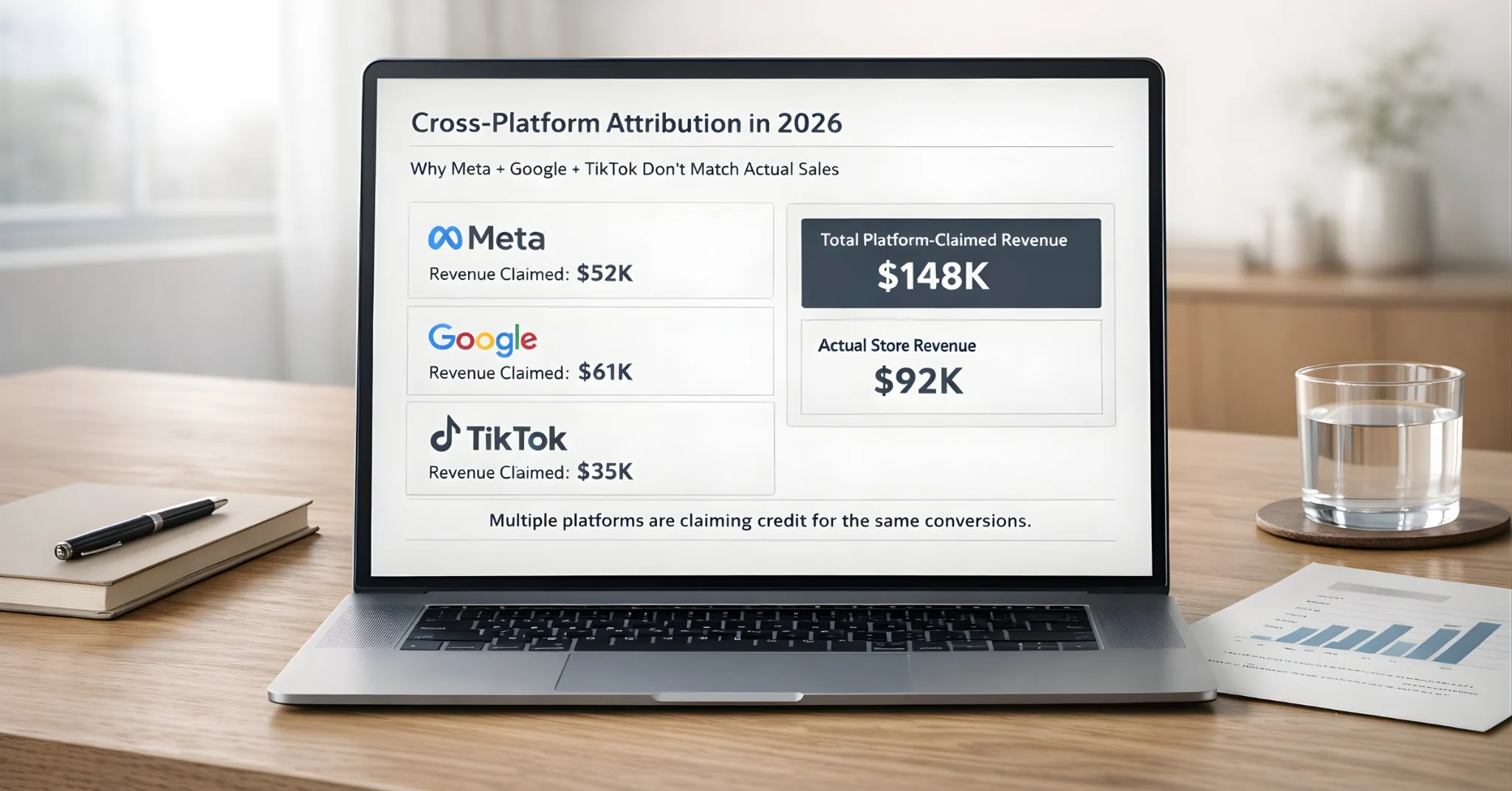
Cross-Platform Attribution in 2026: Why Meta + Google + TikTok ≠ Your Actual Sales
Panto Source
You check your dashboards. Meta says 487 conversions. Google claims 512. TikTok reports 203. Add them up: 1,202 conversions.
Then you check Shopify: 650 orders.
This isn't a glitch. It's multi-platform attribution working exactly as designed — with every platform claiming credit for the same customers.
This guide explains why the math never adds up, how to measure your actual attribution inflation, and what to do about it in 2026.
The Math Problem in 30 Seconds
Every ad platform grades its own homework. When a customer sees your TikTok ad, clicks your Google search result, and converts after a Meta retargeting ad, all three platforms claim that single sale as their own.
THE DOUBLE-COUNTING PROBLEM════════════════════════════════════════════════════════════════════════════ONE CUSTOMER JOURNEY:Day 1:Sees TikTok ad(doesn't click)
Day 3:Clicks Google Search ad
Day 5:Sees Meta retargeting adDay 7:Returns direct to site → Purchases─────────────────────────────────────────────────────────────────────────WHAT EACH PLATFORM REPORTS:
TikTok: +1conversion(7-day view-through)
Google: +1conversion(30-day click)
Meta: +1conversion(7-day click,1-day view)TOTAL REPORTED:3conversionsACTUAL SALES:1order─────────────────────────────────────────────────────────────────────────SCALE THIS ACROSS 650 ORDERS:Platform reports:1,200+ "conversions"Shopify orders:650actual salesAttribution Inflation:85%
════════════════════════════════════════════════════════════════════════════
THE DOUBLE-COUNTING PROBLEM════════════════════════════════════════════════════════════════════════════ONE CUSTOMER JOURNEY:Day 1:Sees TikTok ad(doesn't click)
Day 3:Clicks Google Search ad
Day 5:Sees Meta retargeting adDay 7:Returns direct to site → Purchases─────────────────────────────────────────────────────────────────────────WHAT EACH PLATFORM REPORTS:
TikTok: +1conversion(7-day view-through)
Google: +1conversion(30-day click)
Meta: +1conversion(7-day click,1-day view)TOTAL REPORTED:3conversionsACTUAL SALES:1order─────────────────────────────────────────────────────────────────────────SCALE THIS ACROSS 650 ORDERS:Platform reports:1,200+ "conversions"Shopify orders:650actual salesAttribution Inflation:85%
════════════════════════════════════════════════════════════════════════════
THE DOUBLE-COUNTING PROBLEM════════════════════════════════════════════════════════════════════════════ONE CUSTOMER JOURNEY:Day 1:Sees TikTok ad(doesn't click)
Day 3:Clicks Google Search ad
Day 5:Sees Meta retargeting adDay 7:Returns direct to site → Purchases─────────────────────────────────────────────────────────────────────────WHAT EACH PLATFORM REPORTS:
TikTok: +1conversion(7-day view-through)
Google: +1conversion(30-day click)
Meta: +1conversion(7-day click,1-day view)TOTAL REPORTED:3conversionsACTUAL SALES:1order─────────────────────────────────────────────────────────────────────────SCALE THIS ACROSS 650 ORDERS:Platform reports:1,200+ "conversions"Shopify orders:650actual salesAttribution Inflation:85%
════════════════════════════════════════════════════════════════════════════
This isn't fraud. It's how attribution windows work — each platform counts any customer who touched their ads within their lookback window, regardless of what other platforms also touched.
An 85% inflation rate means your platforms are collectively claiming nearly double your actual conversions. Every budget decision you make based on platform ROAS is built on inflated numbers.
ATTRIBUTION INFLATION SCALE════════════════════════════════════════════════════════════════════════════YOUR INFLATION RATE:0% 30% 60% 100% 150% 200%+
│ │ │ │ │ │▼ ▼ ▼ ▼ ▼ ▼├──────────┼──────────┼──────────┼──────────┼──────────┤│ HEALTHY │ MODERATE │ HIGH │ SEVERE │ CRITICAL │├──────────┼──────────┼──────────┼──────────┼──────────┤HEALTHY(0-30%): Minimal platform overlap. Data is usable.
MODERATE (30-60%): Typical for multi-channel. Adjust decisions.
HIGH(60-100%): Significant double-counting. Don't trust ROAS.
SEVERE (100-150%): Platforms claim 2x your actual sales.
CRITICAL (150%+):
ATTRIBUTION INFLATION SCALE════════════════════════════════════════════════════════════════════════════YOUR INFLATION RATE:0% 30% 60% 100% 150% 200%+
│ │ │ │ │ │▼ ▼ ▼ ▼ ▼ ▼├──────────┼──────────┼──────────┼──────────┼──────────┤│ HEALTHY │ MODERATE │ HIGH │ SEVERE │ CRITICAL │├──────────┼──────────┼──────────┼──────────┼──────────┤HEALTHY(0-30%): Minimal platform overlap. Data is usable.
MODERATE (30-60%): Typical for multi-channel. Adjust decisions.
HIGH(60-100%): Significant double-counting. Don't trust ROAS.
SEVERE (100-150%): Platforms claim 2x your actual sales.
CRITICAL (150%+):
ATTRIBUTION INFLATION SCALE════════════════════════════════════════════════════════════════════════════YOUR INFLATION RATE:0% 30% 60% 100% 150% 200%+
│ │ │ │ │ │▼ ▼ ▼ ▼ ▼ ▼├──────────┼──────────┼──────────┼──────────┼──────────┤│ HEALTHY │ MODERATE │ HIGH │ SEVERE │ CRITICAL │├──────────┼──────────┼──────────┼──────────┼──────────┤HEALTHY(0-30%): Minimal platform overlap. Data is usable.
MODERATE (30-60%): Typical for multi-channel. Adjust decisions.
HIGH(60-100%): Significant double-counting. Don't trust ROAS.
SEVERE (100-150%): Platforms claim 2x your actual sales.
CRITICAL (150%+):
Why Every Platform Over-Reports
Each platform has a different attribution window — the lookback period they use to claim credit for conversions.
Attribution Windows by Platform (2026)
Platform
Click Window
View Window
Meta
7 days (configurable)
1 day (default)
Google Ads
30 days (default)
N/A (search)
TikTok
7 days (default)
7 days (default)
Pinterest
30 days
1 day
Snapchat
28 days
1 day
The overlap problem: A customer clicks a Google ad on Day 1, views a TikTok ad on Day 3, and converts on Day 6. Google claims it (within 30-day click window). TikTok claims it (within 7-day view window). Both report +1 conversion for the same $100 order.
Longer windows = more claimed conversions. A platform with a 30-day window will always report more conversions than one with a 7-day window, even if their actual contribution is identical.
The Phantom Conversion Problem
Double-counting is bad enough. But there's a second layer: platforms also report conversions they never actually saw.
When iOS privacy, browser blocking, and ad blockers hide 40-60% of your actual conversions, platforms fill the gap with modeled estimates.
THE PHANTOM CONVERSION BREAKDOWN════════════════════════════════════════════════════════════════════════════YOUR 650ACTUAL SHOPIFY ORDERS:┌───────────────────────────────────────────────────────────────────┐│ ││ OBSERVED by platforms: ~350orders(54%)││ BLOCKED by iOS/browsers: ~300orders(46%)││ │└───────────────────────────────────────────────────────────────────┘─────────────────────────────────────────────────────────────────────────WHAT PLATFORMS REPORT:Actually observed:350conversionsModeled/estimated:200+ "conversions"(filling thegap)Double-counted(overlap):650+ "conversions"─────────────────────────────Total platform reports:1,200+ "conversions"─────────────────────────────────────────────────────────────────────────THE RESULT:Some conversions are counted twice(overlap)Some conversions are guesses(modeled)Some conversions are invisible(blocked butnotmodeled)Your "data"is a mix of real,estimated,and fictional numbers.
════════════════════════════════════════════════════════════════════════════
THE PHANTOM CONVERSION BREAKDOWN════════════════════════════════════════════════════════════════════════════YOUR 650ACTUAL SHOPIFY ORDERS:┌───────────────────────────────────────────────────────────────────┐│ ││ OBSERVED by platforms: ~350orders(54%)││ BLOCKED by iOS/browsers: ~300orders(46%)││ │└───────────────────────────────────────────────────────────────────┘─────────────────────────────────────────────────────────────────────────WHAT PLATFORMS REPORT:Actually observed:350conversionsModeled/estimated:200+ "conversions"(filling thegap)Double-counted(overlap):650+ "conversions"─────────────────────────────Total platform reports:1,200+ "conversions"─────────────────────────────────────────────────────────────────────────THE RESULT:Some conversions are counted twice(overlap)Some conversions are guesses(modeled)Some conversions are invisible(blocked butnotmodeled)Your "data"is a mix of real,estimated,and fictional numbers.
════════════════════════════════════════════════════════════════════════════
THE PHANTOM CONVERSION BREAKDOWN════════════════════════════════════════════════════════════════════════════YOUR 650ACTUAL SHOPIFY ORDERS:┌───────────────────────────────────────────────────────────────────┐│ ││ OBSERVED by platforms: ~350orders(54%)││ BLOCKED by iOS/browsers: ~300orders(46%)││ │└───────────────────────────────────────────────────────────────────┘─────────────────────────────────────────────────────────────────────────WHAT PLATFORMS REPORT:Actually observed:350conversionsModeled/estimated:200+ "conversions"(filling thegap)Double-counted(overlap):650+ "conversions"─────────────────────────────Total platform reports:1,200+ "conversions"─────────────────────────────────────────────────────────────────────────THE RESULT:Some conversions are counted twice(overlap)Some conversions are guesses(modeled)Some conversions are invisible(blocked butnotmodeled)Your "data"is a mix of real,estimated,and fictional numbers.
════════════════════════════════════════════════════════════════════════════
Meta's Aggregated Event Measurement, Google's Enhanced Conversions modeling, and TikTok's privacy-era estimates all fill gaps with statistical guesses. These models are proprietary — you can't audit them or understand their assumptions.
THE MISLEADING ROAS COMPARISON════════════════════════════════════════════════════════════════════════════WHAT YOUR DASHBOARDS SHOW:Platform Spend Conversions Revenue ROAS──────── ───── ─────────── ─────── ────Meta $15,000487$48,7003.2xGoogle $12,000512$51,2004.3xTikTok $8,000203$20,3002.5x
DECISION:Shift budget from TikTok(2.5x)to Google(4.3x)─────────────────────────────────────────────────────────────────────────THE REALITY:Total claimed conversions:1,202Actual Shopify orders:650Inflation rate:85%
If we deflate proportionally:Platform Actual Share True Conversions True ROAS──────── ──────────── ──────────────── ─────────Meta ~40% ~2601.7xGoogle ~43% ~2802.3xTikTok ~17% ~1101.4x─────────────────────────────────────────────────────────────────────────THE PROBLEM:You can't know the "actual share" — platforms don't coordinateThe deflation might not be proportionalSome platforms over-claim more than othersEvery budget decision is a guess.
════════════════════════════════════════════════════════════════════════════
THE MISLEADING ROAS COMPARISON════════════════════════════════════════════════════════════════════════════WHAT YOUR DASHBOARDS SHOW:Platform Spend Conversions Revenue ROAS──────── ───── ─────────── ─────── ────Meta $15,000487$48,7003.2xGoogle $12,000512$51,2004.3xTikTok $8,000203$20,3002.5x
DECISION:Shift budget from TikTok(2.5x)to Google(4.3x)─────────────────────────────────────────────────────────────────────────THE REALITY:Total claimed conversions:1,202Actual Shopify orders:650Inflation rate:85%
If we deflate proportionally:Platform Actual Share True Conversions True ROAS──────── ──────────── ──────────────── ─────────Meta ~40% ~2601.7xGoogle ~43% ~2802.3xTikTok ~17% ~1101.4x─────────────────────────────────────────────────────────────────────────THE PROBLEM:You can't know the "actual share" — platforms don't coordinateThe deflation might not be proportionalSome platforms over-claim more than othersEvery budget decision is a guess.
════════════════════════════════════════════════════════════════════════════
THE MISLEADING ROAS COMPARISON════════════════════════════════════════════════════════════════════════════WHAT YOUR DASHBOARDS SHOW:Platform Spend Conversions Revenue ROAS──────── ───── ─────────── ─────── ────Meta $15,000487$48,7003.2xGoogle $12,000512$51,2004.3xTikTok $8,000203$20,3002.5x
DECISION:Shift budget from TikTok(2.5x)to Google(4.3x)─────────────────────────────────────────────────────────────────────────THE REALITY:Total claimed conversions:1,202Actual Shopify orders:650Inflation rate:85%
If we deflate proportionally:Platform Actual Share True Conversions True ROAS──────── ──────────── ──────────────── ─────────Meta ~40% ~2601.7xGoogle ~43% ~2802.3xTikTok ~17% ~1101.4x─────────────────────────────────────────────────────────────────────────THE PROBLEM:You can't know the "actual share" — platforms don't coordinateThe deflation might not be proportionalSome platforms over-claim more than othersEvery budget decision is a guess.
════════════════════════════════════════════════════════════════════════════
Shifting budget based on platform-reported ROAS is like navigating with a broken compass. The numbers move, but they don't point toward reality.
The Cross-Device Black Hole
Customer journeys span multiple devices. Your attribution can't follow them.
THE CROSS-DEVICE IDENTITY PROBLEM════════════════════════════════════════════════════════════════════════════ONE HUMAN,THREE "GHOSTS":📱 Phone 💻 Laptop 📱 Tablet│ │ │▼ ▼ ▼┌──────────┐ ┌──────────┐ ┌──────────┐│ User A │ │ User B │ │ User C ││(anon)│ │(anon)│ │(anon)│└──────────┘ └──────────┘ └──────────┘│ │ │▼ ▼ ▼Sees IG ad Clicks Google Direct visit(no action)(researches)(purchases)─────────────────────────────────────────────────────────────────────────YOUR TRACKING SEES:3anonymous users,1conversion(Direct)
REALITY:1customer,influenced by Instagram and Google════════════════════════════════════════════════════════════════════════════
THE CROSS-DEVICE IDENTITY PROBLEM════════════════════════════════════════════════════════════════════════════ONE HUMAN,THREE "GHOSTS":📱 Phone 💻 Laptop 📱 Tablet│ │ │▼ ▼ ▼┌──────────┐ ┌──────────┐ ┌──────────┐│ User A │ │ User B │ │ User C ││(anon)│ │(anon)│ │(anon)│└──────────┘ └──────────┘ └──────────┘│ │ │▼ ▼ ▼Sees IG ad Clicks Google Direct visit(no action)(researches)(purchases)─────────────────────────────────────────────────────────────────────────YOUR TRACKING SEES:3anonymous users,1conversion(Direct)
REALITY:1customer,influenced by Instagram and Google════════════════════════════════════════════════════════════════════════════
THE CROSS-DEVICE IDENTITY PROBLEM════════════════════════════════════════════════════════════════════════════ONE HUMAN,THREE "GHOSTS":📱 Phone 💻 Laptop 📱 Tablet│ │ │▼ ▼ ▼┌──────────┐ ┌──────────┐ ┌──────────┐│ User A │ │ User B │ │ User C ││(anon)│ │(anon)│ │(anon)│└──────────┘ └──────────┘ └──────────┘│ │ │▼ ▼ ▼Sees IG ad Clicks Google Direct visit(no action)(researches)(purchases)─────────────────────────────────────────────────────────────────────────YOUR TRACKING SEES:3anonymous users,1conversion(Direct)
REALITY:1customer,influenced by Instagram and Google════════════════════════════════════════════════════════════════════════════
Example: A Typical Cross-Device Journey
What actually happened:
Phone (lunch): Sees Instagram ad → Interested but busy
Laptop (evening): Searches brand on Google → Researches
Tablet (weekend): Returns directly → Purchases
What your tracking sees:
Phone: Anonymous impression (no login)
Laptop: Anonymous click (different cookies)
Tablet: Direct visit → Purchase (no attribution)
Attribution result:
Instagram: 0 conversions (can't connect to purchase)
Google: 0 conversions (can't connect to purchase)
Direct: +1 conversion (gets all credit)
Your analysis: "Instagram and Google don't convert. Direct traffic is our best channel."
Reality: Instagram built awareness. Google enabled research. Both were essential. You just can't see it.
2026 Reality: Probabilistic Matching Is Dead
In 2026, cross-device tracking has become even harder:
Google's Privacy Sandbox restricts the signals available for probabilistic matching
Apple's Private Advertising API limits cross-app identity signals on iOS
Browser fingerprinting is increasingly blocked by default
The only reliable bridge across devices is now server-side first-party identifiers — hashed email addresses, phone numbers, or account IDs that you collect directly from customers. Without logged-in users or deterministic matching, cross-device journeys appear as separate anonymous visitors.
2026 Update: Meta's Attribution Overhaul
In March 2026, Meta announced significant changes to how it defines "clicks" for attribution. Previously, likes, shares, and saves counted as clicks — inflating click-through attribution numbers.
Before (Pre-March 2026)
"Click" included:
Link clicks (actual site visits)
Likes
Shares
Saves
Comments
Result: Inflated click-through conversions
After (March 2026+)
Click-through attribution: Only link clicks that lead to website
New "Engaged-view" category: Social engagement actions (likes, shares, saves) — separate from click attribution
Impact on Your Data
Click-through conversion numbers will drop
This is more accurate, not worse performance
Historical comparisons will be misleading
Your "baseline" ROAS needs recalibration
Don't Panic: Lower ROAS ≠ Lower Profit
When you see your Meta ROAS drop after this update, remember:
Your actual revenue hasn't changed. The same customers are buying. The same ads are working. Meta just stopped counting "fluff" (likes, saves) as clicks.
If your ROAS was 4.2x before March 2026 and drops to 2.8x after:
Your real ROAS was always closer to 2.8x
The "missing" 1.4x was inflated by social engagement clicks
You're now seeing a more honest picture of click-driven performance
What to do:
Don't cut budget based on the apparent "drop"
Establish new baselines using post-March 2026 data only
Use the new "Engaged-view" metric to understand social engagement value separately
This change makes Meta reporting more honest — but it also means your historical data is incompatible with current reporting. Any trend analysis crossing March 2026 is comparing apples to oranges.
The Fix: Unified Attribution
Platform-native reporting can't solve multi-platform attribution because platforms are competitors, not collaborators. The fix requires a source of truth outside the platforms.
Server-side tracking bypasses browser blocking to capture more conversions. When your server sends conversion data directly to platforms via Conversions APIs, you recover the 40-60% of events that client-side pixels miss.
First-party data collection (email, phone, account IDs) creates persistent identifiers that survive cookie deletion and cross-device journeys.
To see how the system recovers lost signals end-to-end — server-side capture, identity stitching, deduplication, and CAPI delivery as a single connected workflow — that walkthrough makes the infrastructure concrete. For a deeper look at how attribution models compare, that guide covers each model's tradeoffs.
Warning: The Last-Click Trap in Unified Tools
Even unified attribution tools often default to last-click attribution — which naturally over-credits Google Search (it's usually the final touchpoint before purchase). For how attribution models compare — first-touch, linear, time-decay, position-based, and data-driven — see that breakdown before choosing your model.
For 2026's longer, multi-device customer journeys, consider these models instead:
Model
Best For
How It Works
Time Decay
Long consideration cycles
Recent touchpoints get more credit, but earlier ones still count
Linear
Understanding full journey
Equal credit to every touchpoint
Position-Based
Valuing discovery + conversion
40% first touch, 40% last touch, 20% middle
Pro tip: If Google Search dominates your attributed revenue but you're spending heavily on Meta/TikTok awareness campaigns, you likely have a last-click bias problem. Switch to Time Decay to see if those upper-funnel channels are actually driving the searches. For the foundational explainer on how attribution models connect here (anchor pending grammar fix), see that guide.
The Gold Standard: Incrementality Testing
Even the best multi-touch attribution can't answer the ultimate question: Would this sale have happened anyway?
View-through conversions are especially suspect. Did that TikTok ad cause the purchase, or did the customer just happen to see it before buying something they'd already decided to purchase?
Conversion Lift Tests (incrementality testing) answer this by comparing:
Test group: Sees your ads
Control group: Doesn't see your ads
Measurement: Difference in conversions between groups
This is the 2026 gold standard for proving a channel actually drives new sales rather than just claiming sales that were going to happen regardless. Use incrementality to validate your attribution model's conclusions.
Question: "Am I capturing conversion events at all?"
Pixel implementation
Event setup (ViewContent, AddToCart, Purchase)
Data layer configuration
Build From the Bottom Up
Attribution without Persistence = Attributing incomplete data
Persistence without Collection = Nothing to persist
All three layers work together.
If you're losing 40-60% of conversions to iOS and browser blocking (Layer 2), your attribution data (Layer 3) is 40-60% fictional. Fix the foundation before optimizing the attribution model.
Diagnostic Checklist
Use this to assess your multi-platform attribution health:
Step 1: Calculate Inflation Rate
Sum all platform-reported conversions (same time period)
Compare to backend conversions (Shopify orders)
Calculate: (Platform Total / Backend) - 1 × 100
Benchmark: <30% healthy, 30-60% moderate, >60% high
Can you match mobile browsing to desktop purchases?
Step 5: Evaluate Unified Solution
Do you have a single source of truth for conversions?
Are you using server-side tracking?
Is Conversions API implemented for major platforms?
Can you run multi-touch attribution across all channels?
The Bottom Line
Every ad platform will tell you they're your best performer. That's their job — they're selling you ad inventory, not giving you objective measurement.
The math is simple: if your platforms collectively report more conversions than you actually have orders, someone is lying. Usually, everyone is lying — not maliciously, but structurally. Each platform claims credit for overlapping customers using incompatible attribution windows.
The fix requires three things:
Fix your tracking foundation (server-side, CAPI) so you're attributing real data, not gaps
Implement unified attribution that sees all platforms and deduplicates conversions
Use your backend (Shopify/CRM) as the source of truth, not platform dashboards
Platform-reported ROAS is marketing. Backend revenue is reality. Build your attribution system on reality.
Get Started
Start Tracking Every Sale Today
Join 1,389+ e-commerce stores. Set up in 5 minutes, see results in days.