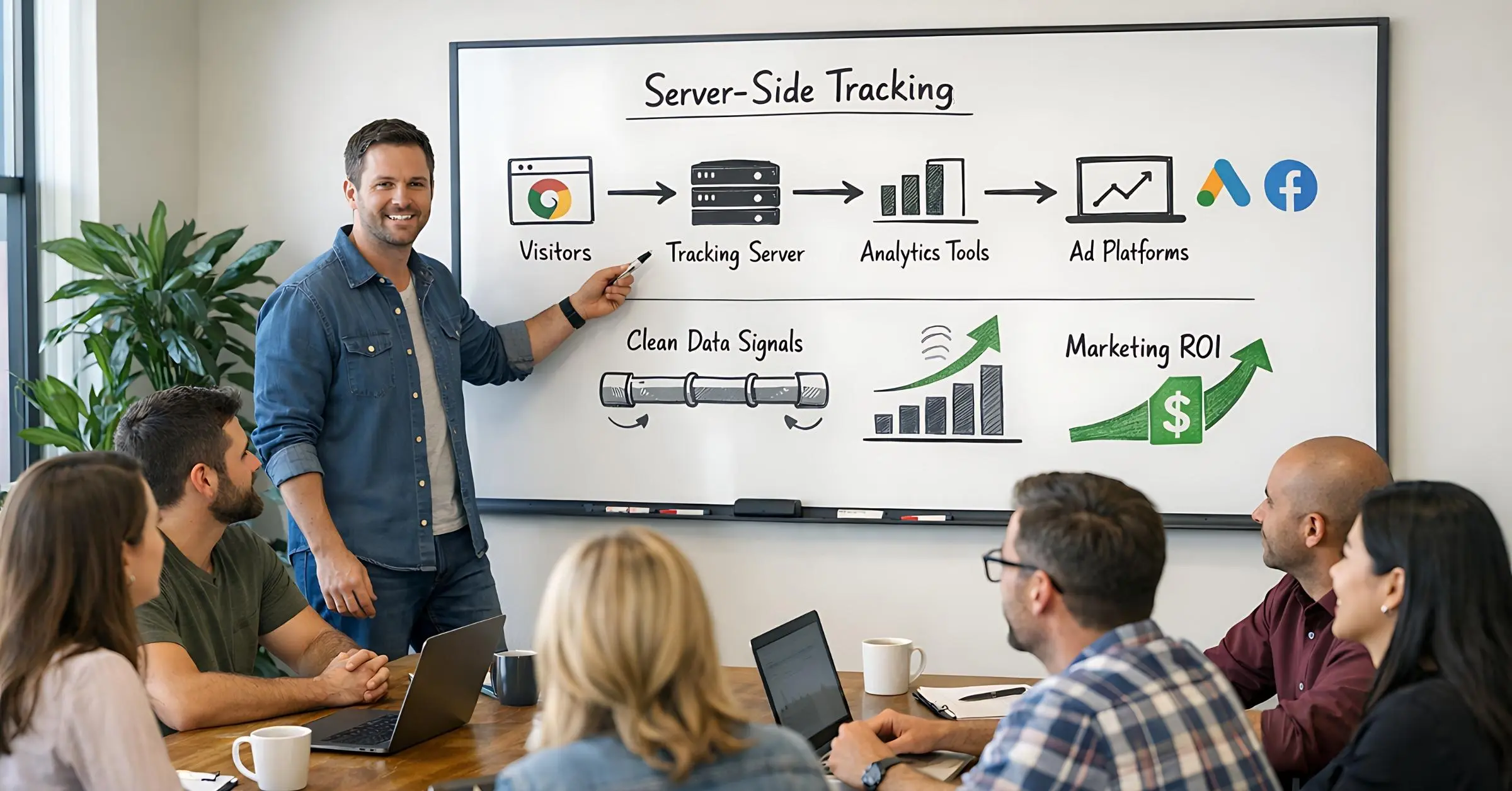
Server-Side Tracking ROI: Why It Pays for Itself in 30 Days
Panto Source
Your Meta dashboard shows 70 purchases. Your Shopify backend shows 100. That's not a reporting bug — it's 30 conversions that never reached the ad platform.
Those missing conversions aren't just invisible in reports. They're invisible to the algorithm. Meta can't optimize toward customers it doesn't know exist. The result: higher CPAs, worse targeting, and budget allocated to the wrong campaigns.
Server-side tracking fixes this. Not in theory — in measurable, revenue-impacting ways.
The Business Case in Numbers
Before diving into benefits, here's what the data shows:
SERVER-SIDE TRACKING:THE NUMBERS THAT MATTER═══════════════════════════════════════════════════════════════════════CONVERSION RECOVERY:├── Client-side tracking captures:60-80% of conversions├── Server-side tracking captures:95-99% of conversions└── Gap recovered:20-40% of previously lost conversionsROAS IMPACT:├── Average ROAS lift after implementation:23%
├── EMQ(Event MatchQuality) improvement:2-3points├── CPA reduction from better data:15-25%
└── Payback period:Typically under 30daysCOST STRUCTURE:├── Managed solutions:$100-500/month├── Self-hosted sGTM:$50-200/month(hosting)└── ROI at $50K/month ad spend:10-50x returnon tracking cost
SERVER-SIDE TRACKING:THE NUMBERS THAT MATTER═══════════════════════════════════════════════════════════════════════CONVERSION RECOVERY:├── Client-side tracking captures:60-80% of conversions├── Server-side tracking captures:95-99% of conversions└── Gap recovered:20-40% of previously lost conversionsROAS IMPACT:├── Average ROAS lift after implementation:23%
├── EMQ(Event MatchQuality) improvement:2-3points├── CPA reduction from better data:15-25%
└── Payback period:Typically under 30daysCOST STRUCTURE:├── Managed solutions:$100-500/month├── Self-hosted sGTM:$50-200/month(hosting)└── ROI at $50K/month ad spend:10-50x returnon tracking cost
SERVER-SIDE TRACKING:THE NUMBERS THAT MATTER═══════════════════════════════════════════════════════════════════════CONVERSION RECOVERY:├── Client-side tracking captures:60-80% of conversions├── Server-side tracking captures:95-99% of conversions└── Gap recovered:20-40% of previously lost conversionsROAS IMPACT:├── Average ROAS lift after implementation:23%
├── EMQ(Event MatchQuality) improvement:2-3points├── CPA reduction from better data:15-25%
└── Payback period:Typically under 30daysCOST STRUCTURE:├── Managed solutions:$100-500/month├── Self-hosted sGTM:$50-200/month(hosting)└── ROI at $50K/month ad spend:10-50x returnon tracking cost
The 8 Benefits (Organized by Business Impact)
Revenue Benefits
1. Recover 20-40% of Lost Conversions
This is the most immediate ROI. Every conversion your pixel misses is a conversion the algorithm can't learn from.
What causes the loss:
Ad blockers (30%+ of users)
Safari ITP (7-day cookie cap)
iOS privacy settings (75-85% opt-out)
Page abandonment before pixel fires
JavaScript errors and slow page loads
What server-side fixes-see That's the difference between Meta guessing and Meta knowing. To see the technical setup behind accurate tracking — server capture, hashing, fbclid preservation, and CAPI delivery as a single connected workflow — that walkthrough makes the architecture concrete.That's the difference between Meta guessing and Meta knowing.
5. Enrich Conversions with Backend Data
When events flow through your server, you can enrich them with data the browser never sees. This transforms basic conversion tracking into a strategic optimization engine.
What you can add:
Customer lifetime value (LTV)
Customer segment (new vs. returning, VIP tier)
Product margin (optimize for profit, not just revenue)
Lead quality score (for B2B)
Offline conversion data (CRM, call center, in-store)
Days since last purchase
Product category preferences
The optimization shift:
BASIC PIXEL DATA:"Someone bought something for $149"→ Meta optimizes for:Anyone who buysENRICHED SERVER-SIDE DATA:"High-LTV repeat customer bought running shoes, 45 days since last order, VIP tier"→ Meta optimizes for:High-value customers who actually drive profit
BASIC PIXEL DATA:"Someone bought something for $149"→ Meta optimizes for:Anyone who buysENRICHED SERVER-SIDE DATA:"High-LTV repeat customer bought running shoes, 45 days since last order, VIP tier"→ Meta optimizes for:High-value customers who actually drive profit
BASIC PIXEL DATA:"Someone bought something for $149"→ Meta optimizes for:Anyone who buysENRICHED SERVER-SIDE DATA:"High-LTV repeat customer bought running shoes, 45 days since last order, VIP tier"→ Meta optimizes for:High-value customers who actually drive profit
Why this matters: Same ad spend, dramatically better outcomes. Brands using enriched data report finding customers with 2-3x higher LTV than those optimizing on basic conversion signals alone.
Compliance & Control Benefits
6. Own Your Data Pipeline (Full Visibility)
With client-side tracking, you trust what happens in the browser. You can't see exactly what data is collected or where it goes. It's a black box controlled by third-party scripts.
Server-side tracking creates an auditable chokepoint — every piece of data passes through your server first.
What you control:
Exactly what data is collected
What gets sent to each platform
What PII is hashed, anonymized, or redacted
Which events fire based on consent status
Complete logs of all data transmission
Why this matters in 2026:
GDPR auditors want proof of data processing
CCPA/CPRA requires demonstrable compliance
Google Consent Mode v3 requires proper consent handling
One auditable log beats scattered browser scripts
The compliance advantage: When a regulator asks "what data do you send to Meta?", you have a single, timestamped server log showing exactly what was sent, to whom, and under what consent conditions. That's impossible with client-side tracking.
7. Protect API Keys and Prevent Spam
Client-side pixels expose sensitive information publicly:
Measurement IDs visible in page source
Endpoints that can be spoofed or scraped
Raw event data vulnerable to manipulation
What server-side protects:
API keys stay on your server (never exposed to browsers)
Events are validated before forwarding
Bot traffic and spam filtered at the server level
Malicious conversion injection blocked
Real-world impact: Some businesses see 5-15% of their "conversions" are actually spam or bot traffic. Server-side validation catches these before they pollute your data and distort algorithm training.
8. Improve Site Performance (Faster Load Times)
Client-side tracking loads multiple third-party scripts in the user's browser. Each script adds weight, slows pages, and can conflict with other tools. This is often the "hidden" ROI of server-side tracking.
The Main Thread Problem
Every tracking script competes for your browser's Main Thread — the single process that handles page rendering, user interactions, and JavaScript execution. When tracking scripts block the Main Thread, your site feels slow even if it loads quickly.
MAIN THREAD BLOCKING:THE HIDDEN PERFORMANCE KILLER═══════════════════════════════════════════════════════════════════════CLIENT-SIDE TRACKING(Heavy MainThreadLoad):┌─────────────────────────────────────────────────────────────────────┐│ BROWSER MAIN THREAD ││ ══════════════════════════════════════════════════════════════════││ ││[Page Render]──[Meta Pixel]──[Google Tag]──[TikTok]──[Analytics]││ ↓ ↓ ↓ ↓ ↓ ││ 100ms 150ms 120ms 80ms 100ms ││ ││ Total Main Thread blocking: ~550ms ││ User experience:Sluggish,unresponsive ││ Core Web Vitals:Poor INP,high TBT ││ ││ EACH SCRIPT:││ • Downloads external JavaScript file ││ • Parses and compiles the code ││ • Executes and collects data ││ • Makes network requests(often multiple)││ • Waits forresponses │└─────────────────────────────────────────────────────────────────────┘SERVER-SIDE TRACKING(Minimal MainThreadLoad):┌─────────────────────────────────────────────────────────────────────┐│ BROWSER MAIN THREAD ││ ══════════════════════════════════════════════════════════════════││ ││[Page Render]──[Lightweight DataLayer]││ ↓ ↓ ││ 100ms 30ms ││ ││ Total Main Thread blocking: ~130ms ││ User experience:Fast,responsive ││ Core Web Vitals:Good INP,low TBT ││ ││ WHAT MOVES TO SERVER:││ • Heavy JavaScript execution ││ • Data transformation logic ││ • Multiple API calls(batched server-side)││ • Event validation and deduplication │└─────────────────────────────────────────────────────────────────────┘MEASURABLE IMPACT:├── Main Thread blocking reduced by 60-80%
├── Interaction to Next Paint(INP)improved├── Total Blocking Time(TBT)reduced└── Largest Contentful Paint(LCP)faster
MAIN THREAD BLOCKING:THE HIDDEN PERFORMANCE KILLER═══════════════════════════════════════════════════════════════════════CLIENT-SIDE TRACKING(Heavy MainThreadLoad):┌─────────────────────────────────────────────────────────────────────┐│ BROWSER MAIN THREAD ││ ══════════════════════════════════════════════════════════════════││ ││[Page Render]──[Meta Pixel]──[Google Tag]──[TikTok]──[Analytics]││ ↓ ↓ ↓ ↓ ↓ ││ 100ms 150ms 120ms 80ms 100ms ││ ││ Total Main Thread blocking: ~550ms ││ User experience:Sluggish,unresponsive ││ Core Web Vitals:Poor INP,high TBT ││ ││ EACH SCRIPT:││ • Downloads external JavaScript file ││ • Parses and compiles the code ││ • Executes and collects data ││ • Makes network requests(often multiple)││ • Waits forresponses │└─────────────────────────────────────────────────────────────────────┘SERVER-SIDE TRACKING(Minimal MainThreadLoad):┌─────────────────────────────────────────────────────────────────────┐│ BROWSER MAIN THREAD ││ ══════════════════════════════════════════════════════════════════││ ││[Page Render]──[Lightweight DataLayer]││ ↓ ↓ ││ 100ms 30ms ││ ││ Total Main Thread blocking: ~130ms ││ User experience:Fast,responsive ││ Core Web Vitals:Good INP,low TBT ││ ││ WHAT MOVES TO SERVER:││ • Heavy JavaScript execution ││ • Data transformation logic ││ • Multiple API calls(batched server-side)││ • Event validation and deduplication │└─────────────────────────────────────────────────────────────────────┘MEASURABLE IMPACT:├── Main Thread blocking reduced by 60-80%
├── Interaction to Next Paint(INP)improved├── Total Blocking Time(TBT)reduced└── Largest Contentful Paint(LCP)faster
MAIN THREAD BLOCKING:THE HIDDEN PERFORMANCE KILLER═══════════════════════════════════════════════════════════════════════CLIENT-SIDE TRACKING(Heavy MainThreadLoad):┌─────────────────────────────────────────────────────────────────────┐│ BROWSER MAIN THREAD ││ ══════════════════════════════════════════════════════════════════││ ││[Page Render]──[Meta Pixel]──[Google Tag]──[TikTok]──[Analytics]││ ↓ ↓ ↓ ↓ ↓ ││ 100ms 150ms 120ms 80ms 100ms ││ ││ Total Main Thread blocking: ~550ms ││ User experience:Sluggish,unresponsive ││ Core Web Vitals:Poor INP,high TBT ││ ││ EACH SCRIPT:││ • Downloads external JavaScript file ││ • Parses and compiles the code ││ • Executes and collects data ││ • Makes network requests(often multiple)││ • Waits forresponses │└─────────────────────────────────────────────────────────────────────┘SERVER-SIDE TRACKING(Minimal MainThreadLoad):┌─────────────────────────────────────────────────────────────────────┐│ BROWSER MAIN THREAD ││ ══════════════════════════════════════════════════════════════════││ ││[Page Render]──[Lightweight DataLayer]││ ↓ ↓ ││ 100ms 30ms ││ ││ Total Main Thread blocking: ~130ms ││ User experience:Fast,responsive ││ Core Web Vitals:Good INP,low TBT ││ ││ WHAT MOVES TO SERVER:││ • Heavy JavaScript execution ││ • Data transformation logic ││ • Multiple API calls(batched server-side)││ • Event validation and deduplication │└─────────────────────────────────────────────────────────────────────┘MEASURABLE IMPACT:├── Main Thread blocking reduced by 60-80%
├── Interaction to Next Paint(INP)improved├── Total Blocking Time(TBT)reduced└── Largest Contentful Paint(LCP)faster
The revenue connection: Faster sites convert better. A 1-second improvement in load time can increase conversions by 7%. But the INP (Interaction to Next Paint) impact is even more significant — when users can interact with your page immediately, they're more likely to complete purchases. Server-side tracking doesn't just make your site faster on paper; it makes it feel faster to users.
The Hybrid Approach: Best Practice for 2026
Pure server-side isn't always the answer. The 2026 standard is hybrid tracking — using both methods strategically. For the client side vs server side tracking breakdown that frames the architectural tradeoffs, see that guide.
THE HYBRID MODEL:WHERE EACH METHOD FITS═══════════════════════════════════════════════════════════════════════CLIENT-SIDE(Browser):├── Page views├── Scroll depth├── Video engagement├── Micro-conversions(add to cart,begin checkout)└── Fast signals forreal-time personalizationSERVER-SIDE(Your Server):├── Purchases ✓(highest value—trackreliably)├── Lead submissions ✓├── Subscription events ✓├── High-value conversions ✓└── Any event that drives ROAS decisions
DEDUPLICATION:└── Both send the same event_id so platforms don't double-count
THE HYBRID MODEL:WHERE EACH METHOD FITS═══════════════════════════════════════════════════════════════════════CLIENT-SIDE(Browser):├── Page views├── Scroll depth├── Video engagement├── Micro-conversions(add to cart,begin checkout)└── Fast signals forreal-time personalizationSERVER-SIDE(Your Server):├── Purchases ✓(highest value—trackreliably)├── Lead submissions ✓├── Subscription events ✓├── High-value conversions ✓└── Any event that drives ROAS decisions
DEDUPLICATION:└── Both send the same event_id so platforms don't double-count
THE HYBRID MODEL:WHERE EACH METHOD FITS═══════════════════════════════════════════════════════════════════════CLIENT-SIDE(Browser):├── Page views├── Scroll depth├── Video engagement├── Micro-conversions(add to cart,begin checkout)└── Fast signals forreal-time personalizationSERVER-SIDE(Your Server):├── Purchases ✓(highest value—trackreliably)├── Lead submissions ✓├── Subscription events ✓├── High-value conversions ✓└── Any event that drives ROAS decisions
DEDUPLICATION:└── Both send the same event_id so platforms don't double-count
Why hybrid wins:
Client-side gives you fast engagement data
Server-side gives you reliable conversion data
Together, they provide complete coverage with redundancy
Start with your highest-value conversions. A 10% improvement in tracking $500 purchases matters more than perfect tracking of newsletter signups. Implement server-side for purchases and qualified leads first, then expand.
Who Benefits Most?
Not every business needs server-side tracking immediately. Here's how to prioritize:
High priority — implement now:
Ad spend over $10K/month (ROI is immediate and significant)
Long consideration cycles (B2B, SaaS, high-ticket items)
Struggling with "data discrepancy" between platforms and backend
Facing GDPR/CCPA audits or compliance requirements
Facing GDPR/CCPA audits or compliance requirements. If you run an agency managing multiple client tracking setups, a related guide on server side tracking agencies guide covers the multi-client implementation playbook.
Medium priority — plan for Q1:
Ad spend $2-10K/month (ROI still positive, longer payback)
Mixed device audiences
Moderate consideration cycles (7-30 days)
Can wait:
Low ad spend (under $2K/month) — focus on fundamentals first
Already seeing 90%+ match between platform and backend data
Simple attribution needs (single touchpoint, short cycles)
The Bottom Line
Server-side tracking isn't a technical upgrade — it's a revenue decision.
The math:
If you spend $50K/month on ads
And recover 25% more conversions
And see 23% ROAS improvement from better algorithm training
Against $200/month in tracking costs
ROI is measured in multiples, not percentages
What to do next:
Audit your current gap — Compare platform-reported conversions to backend sales
Prioritize high-value events — Start with purchases and qualified leads
Choose your implementation path — Managed, self-hosted, or platform-native
Implement hybrid tracking — Client-side for engagement, server-side for conversions
Monitor EMQ and match rates — Track improvement over 30-60 days
The brands winning in 2026 aren't debating whether to implement server-side tracking. They implemented it last year and are now operating with complete data while competitors optimize on fragments.
Get Started
Start Tracking Every Sale Today
Join 1,389+ e-commerce stores. Set up in 5 minutes, see results in days.