
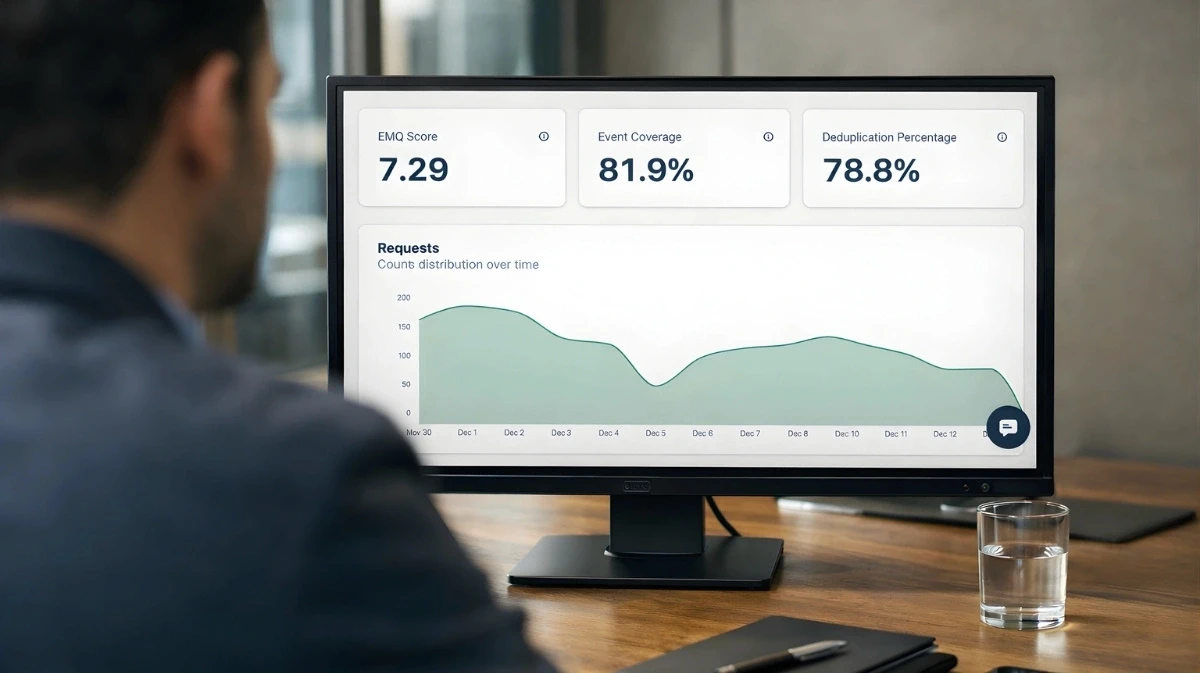
Two Shopify stores. Same product. Same ad spend. Same creative.
Store A has an EMQ of 4.2. Store B has an EMQ of 8.7.
Store A pays $42 CPM. Store B pays $31 CPM. Same audience, same ads — $11 difference per thousand impressions. Over $50K monthly spend, that's $18,000 in wasted budget.
The only difference? How well Meta can match their conversions to real users.
Event Match Quality is one of the most misunderstood metrics in digital advertising. Some advertisers obsess over hitting 10/10. Others ignore it entirely. Both approaches miss the point.
EMQ measures whether ad platforms can connect your conversion events to actual user profiles. When someone buys from your store, can Meta or TikTok confidently say "this purchase came from this specific person who saw this specific ad"?
If yes, the platform can optimize effectively. If no, you're paying a hidden tax on every campaign you run.
This guide explains what EMQ actually measures, what scores you should target, and when it matters most — without the unnecessary complexity.
What EMQ Actually Measures
EMQ is a confidence score from 0-10 that answers one question: Can the platform match this event to a real user?
When a conversion happens on your site, you send data to Meta or TikTok. That data includes identifiers — pieces of information the platform uses to match the event to a user profile.
Strong identifiers (high confidence):
Hashed email address
Hashed phone number
Click ID (fbclid for Meta, ttclid for TikTok)
External ID (your customer ID)
Weak identifiers (low confidence):
IP address
User agent (browser/device info)
Country/region
The more strong identifiers you send, the higher your EMQ. Send just an IP address and user agent? EMQ of 2-3. Send hashed email, phone, and click ID? EMQ of 8-9. To see the tracking flow behind this — including how identifiers get captured, hashed, and delivered to the platform — that walkthrough makes the mechanism concrete.
The Identifier Hierarchy
Not all identifiers are equal. Here's how platforms weight them:
Tier | Identifier | Match Confidence | Notes |
|---|---|---|---|
Tier 1 | Hashed Email | Highest | Most reliable — tied to user accounts |
Tier 1 | Click ID (fbc/ttclid) | Highest | Direct link between ad click and conversion |
Tier 2 | Hashed Phone | High | Strong identifier, but not all users provide |
Tier 2 | External ID | High | Your customer ID — enables cross-device matching |
Tier 3 | fbp/ttp Cookie | Medium | Browser cookie — lost if blocked or cleared |
Tier 4 | IP Address | Low | Shared by households, VPNs, mobile networks |
Tier 4 | User Agent | Low | Supporting signal only — not unique |
The rule: Tier 1 identifiers drive EMQ. Everything else is supplementary.
EMQ Benchmarks by Event Type
Different events naturally have different EMQ scores. This is normal — don't panic if your PageView EMQ is lower than your Purchase EMQ.
Event Type | Expected EMQ | Why |
|---|---|---|
Purchase | 8.5 - 9.5 | Customers provide email, phone, billing info at checkout |
InitiateCheckout | 7.5 - 8.5 | Most customers enter email before completing checkout |
AddToCart | 7.0 - 8.5 | Often logged-in users or returning visitors |
ViewContent | 6.0 - 7.5 | Mix of known and anonymous visitors |
PageView | 5.5 - 7.0 | Mostly anonymous traffic — limited identifiers available |
Key insight: A PageView EMQ of 6.5 isn't a problem — it's physics. Anonymous visitors haven't provided their email yet. Focus your optimization energy on Purchase and AddToCart, where you have the most data to work with.
Meta vs TikTok: EMQ Differences
Both platforms use EMQ, but they calculate and display it differently.
Meta EMQ
Scale: 0-10 numeric score, or Poor/OK/Good/Great labels
Calculation window: Rolling 48 hours
Location: Events Manager → Select event → View "Event Match Quality"
Key identifiers: em (email), ph (phone), fbc (click ID), fbp (browser ID), external_id
Meta shows separate EMQ scores for Pixel events (browser-side) and Conversions API events (server-side). Ideally, both should be high.
TikTok EMQ
Scale: 0-10, calculated as weighted average of match key coverages
Calculation: Based on percentage of events containing each identifier
Location: Events Manager → Diagnostics tab
Key identifiers: email, phone, ttclid (click ID), external_id, IP, user agent
TikTok introduced EMQ in late 2024 and weights it heavily toward email and click ID coverage. If you're missing ttclid on most events, your TikTok EMQ will suffer.
2026 Update: TikTok now penalizes accounts with EMQ below 5.0 by limiting access to certain optimization objectives. If your EMQ is consistently low, you may not be able to use value-based bidding.
When EMQ Actually Matters
Here's the nuanced truth: EMQ isn't equally important in all situations.
EMQ Matters Most When:
1. You're scaling spend At $1K/day, low EMQ is annoying. At $10K/day, it's expensive. The "Poor Data Penalty" — higher CPMs charged to accounts with weak data — compounds with scale.
2. You're running conversion campaigns If you're optimizing for purchases, Meta needs to know who's purchasing. Low EMQ means the algorithm is learning from incomplete data.
3. Your attribution looks broken If Meta reports 200 conversions but your store shows 120, EMQ is often the culprit. Low match quality means conversions can't be attributed to specific ads.
4. You're building audiences Custom Audiences and Lookalikes depend on matched users. Low EMQ = smaller, less accurate audiences.
EMQ Matters Less When:
1. You're optimizing for reach or impressions Brand awareness campaigns don't depend on conversion matching.
2. You're just starting out With limited conversion volume, focus on getting conversions first. EMQ optimization comes second.
3. You're already above 8.0 The difference between 8.5 and 9.5 is marginal. Don't chase perfection — the returns diminish quickly above 8.0.
The 2026 Signal Loss Problem
EMQ has become more important in 2026 because browser-side tracking has become less reliable.
What's blocking your signals:
Blocker | Impact | % of Users Affected |
|---|---|---|
iOS App Tracking Transparency | Blocks cross-app tracking | 75-85% of iOS users |
Ad blockers | Prevents pixel from loading | ~32% of users globally |
GPC (Global Privacy Control) | Browser sends "do not track" header | Growing — default in some browsers |
Safari ITP | Limits cookie lifetime to 7 days | All Safari users |
Brave/Firefox ETP | Blocks third-party tracking | ~8% of users |
The compounding effect: A standard Meta Pixel now loses approximately 35-40% of signals before they ever reach the platform. If you're relying only on browser-side tracking, your EMQ ceiling is artificially limited.
The math: If 35% of your conversion signals are blocked at the browser level, even perfect identifier coverage only gets you to ~6.5 EMQ.Server-side tracking (Conversions API) bypasses these blocks entirely. For the deeper comparison of when each approach fits — and the architectural tradeoffs — see a related guide on client side vs server side tracking.
How to Check Your EMQ
Meta
Go to Events Manager in Business Suite
Select your pixel
Click on any event (Purchase, AddToCart, etc.)
Look for "Event Match Quality" section
Click the score to see which identifiers you're sending
TikTok
Go to TikTok Ads Manager
Navigate to Assets → Events
Select your pixel
Click Diagnostics tab
Review EMQ score and match key coverage
Pro tip: Check EMQ weekly. It's calculated on a rolling window, so changes in traffic patterns or tracking issues show up quickly.
Improving EMQ: What Actually Works
1. Implement Server-Side Tracking
Browser pixels get blocked. Server-side APIs (Meta Conversions API, TikTok Events API) send data directly from your server, bypassing blockers. For the architectural breakdown of how server-side data flows — from event capture through CAPI delivery — see that guide.
Impact: Typically adds 2-3 points to EMQ scores.
2. Send Hashed Email on Every Conversion
Email is the strongest identifier. If you're capturing email at checkout (you should be), make sure it's being sent to the platforms — properly hashed with SHA256. For the Shopify-specific implementation path — including theme integration and customer data capture — see a related guide on first party tracking shopify setup.
Impact: Single biggest EMQ improvement for most stores.
3. Preserve Click IDs
When someone clicks your ad, the platform appends a click ID to the URL (fbclid, ttclid). If your site strips these parameters or they get lost in redirects, you lose your strongest attribution signal.
Check: Do your landing page URLs preserve the click ID through to checkout?
4. Enable Advanced Matching
Both Meta and TikTok offer "Advanced Matching" — automatic detection of customer data from form fields. Enable it in Events Manager as a baseline.
Limitation: Only works when the pixel actually fires. Doesn't help with blocked users.
5. Send External ID
Your customer ID (from Shopify, WooCommerce, etc.) helps platforms match users across devices and sessions. It's underutilized but powerful.
The Bottom Line
EMQ isn't a vanity metric — it directly affects your ad costs and campaign performance. But it's also not something to obsess over.
The practical approach:
Check your current EMQ for Purchase and AddToCart events
If below 6.0: You have a tracking problem. Implement server-side tracking.
If 6.0-8.0: Room for improvement. Focus on sending email and preserving click IDs.
If above 8.0: You're in good shape. Monitor weekly but don't chase 10/10.
The platforms want your data to be matchable — it makes their algorithms work better. But they've made it your responsibility to send that data correctly. In 2026, with browser tracking increasingly unreliable, server-side implementation isn't optional anymore.
The stores winning on Meta and TikTok aren't just making better ads. They're sending better data.
Get Started
Start Tracking Every Sale Today
Join 10+ e-commerce stores. Set up in 5 minutes, see results in days.