You've fixed your tracking. Every conversion fires. But your ad performance still lags. Here's the piece most brands miss — and why enriched signals outperform raw data every time.
There's a conversation happening in every e-commerce Slack channel right now: "We finally got our tracking working, but our ROAS still isn't improving."
It's a frustrating place to be. You did everything right. You set up server-side tracking. You connected Meta's Conversion API. Your conversions match your Shopify dashboard.
And yet, your cost per acquisition keeps climbing. Your campaigns exit the learning phase slower than competitors. Your event match Quality score is stuck at "Good" instead of "Great." For the foundational event match quality EMQ guide, see that breakdown — it covers the score components in detail
The problem isn't accuracy. It's enrichment — or rather, the lack of it.
The Accuracy Trap
Accurate tracking means your ad platforms see every conversion that happens. That's the baseline. In 2026, with browser-based pixels capturing only 40-60% of conversions, getting to 100% visibility is a real achievement.
But here's what most brands miss: accuracy tells the platform that a conversion happened. Enrichment tells the platform who converted and what kind of conversion it was.
These are fundamentally different signals — and they produce fundamentally different results.
Think of it this way: imagine telling a friend about someone you met at a party.
Accuracy alone: "I met someone."
Accuracy + Enrichment: "I met a 35-year-old marketing director from Austin who bought your product twice before, spends $200+ per order, and clicked your ad on mobile but converted on desktop three days later."
Which description helps your friend find more people like that?
The ad platforms work the same way. Raw conversion data tells Meta a purchase happened. Enriched conversion data helps Meta understand who your best customers are — and find more of them.For the client side vs server side tracking breakdown — the architectural decision that determines what data you can enrich in the first place — see that guide.
What Is Signal Enrichment?
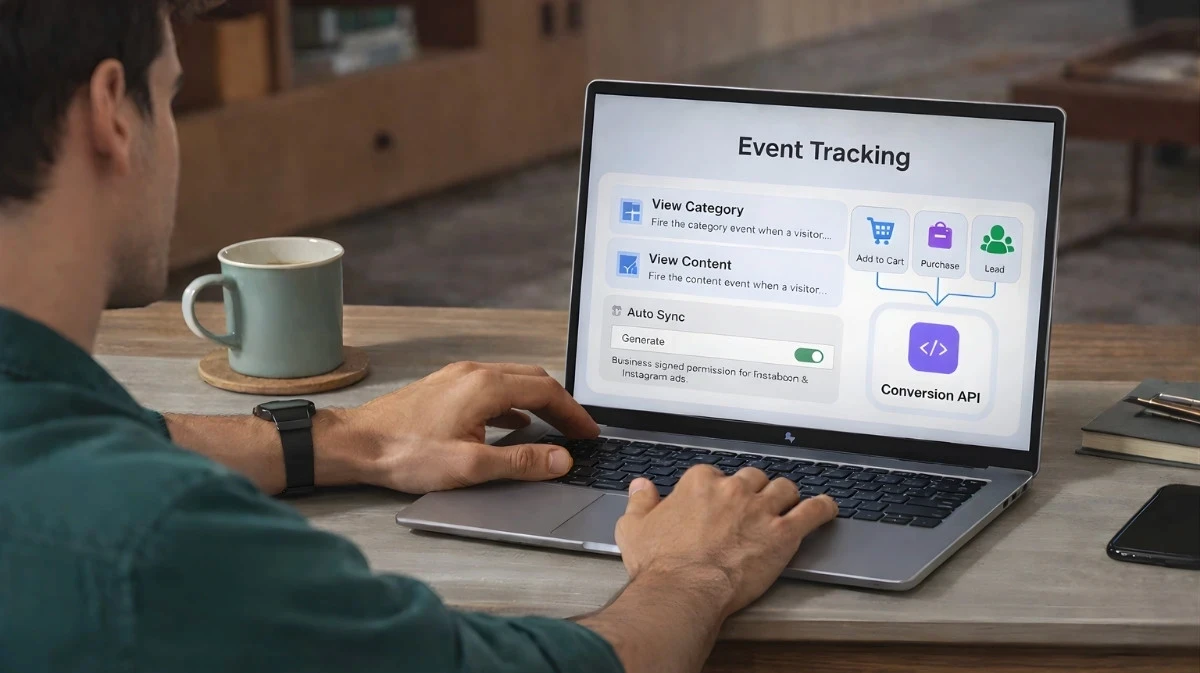
Signal enrichment is the process of adding context to your conversion data before it reaches ad platforms. Instead of sending a bare "Purchase" event, you send a purchase event wrapped in additional data points that help the algorithm learn faster and optimize better.
The Data Points That Matter
Customer identifiers Email addresses, phone numbers, and external IDs that help the platform match conversions back to ad interactions — even across devices. This is what drives Event Match Quality scores.
Transaction context Order value, currency, number of items, product categories. These signals help the platform understand the quality of the conversion, not just that it occurred.
Customer history Is this a first-time buyer or a repeat customer? What's their historical order value? Are they a high-value customer worth acquiring, or a one-time discount shopper?
Behavioral signals Time between ad click and purchase, device used for each step, engagement depth on your site before converting.
Why This Matters for Algorithm Performance
Modern ad platforms don't optimize for conversions — they optimize for predicted conversions. Meta's Advantage+ and Google's Performance Max use machine learning to identify users likely to convert based on patterns in your historical data.
The richer your historical data, the better the prediction models. Brands sending enriched signals give the algorithm more patterns to learn from. Brands sending raw conversion data force the algorithm to work with less information.
Over time, this gap compounds. The brand with enriched data gets better predictions, which leads to better results, which generates more data, which improves predictions further. The brand with raw data falls behind.
The Event Match Quality Problem
Meta's Event Match Quality (EMQ) score is the clearest indicator of whether your signal enrichment is working.
EMQ measures how well Meta can match your conversion events back to users on their platform. A higher score means better matching, which means better attribution, which means better optimization.
Here's what affects EMQ:
Data Point | Impact on EMQ |
|---|---|
Email (hashed) | High |
Phone number (hashed) | High |
First name + Last name | Medium |
City + State + Zip | Medium |
External ID | Medium |
Client IP address | Low |
User agent | Low |
Most server-side tracking solutions send conversions accurately. Fewer send them with complete customer identifiers. Even fewer normalize and hash that data correctly before transmission.
The result: two brands can both have "100% accurate" tracking, but one has an EMQ of 5.2 and the other has an EMQ of 8.7. The second brand's campaigns will outperform — not because they track more conversions, but because Meta can use those conversions more effectively.
Signal Resilience: The 2026 Framework
The brands winning in 2026 aren't just tracking accurately — they're building what the industry calls "Signal Resilience."
Signal Resilience means your data pipeline delivers high-quality, enriched conversion data to ad platforms regardless of:
Browser restrictions
Ad blockers
iOS privacy settings
Cookie deprecation
Cross-device customer journeys
It's a data architecture that bypasses browser limitations entirely — capturing conversions at the source (your e-commerce backend) and enriching them before they reach the ad platforms.
The Three Pillars of Signal Resilience
1. Server-Side Capture Conversions are recorded when they happen in your backend system — not when a pixel fires in a browser. This eliminates the 40-60% data loss from privacy restrictions.To see how server-side signal recovery works end-to-end on a live account — capture, identity stitching, enrichment, CAPI delivery — that walkthrough makes the architecture concrete.
2. Identity Resolution Customer data is normalized, validated, and matched across touchpoints. The same customer appearing on mobile, desktop, and email is recognized as one person, not three.
3. Contextual Enrichment Each conversion is enhanced with relevant context — customer lifetime value indicators, purchase history, behavioral signals — before being sent to ad platforms.
Brands with all three pillars see measurably better results: faster learning phases, lower CPAs, higher Event Match Quality scores, and more efficient scaling. For the infrastructure pillar — server-side data flows — that explains how capture, identity resolution, and enrichment connect end-to-end, see that breakdown.
Why Most Brands Stop at Accuracy
If enrichment is so valuable, why do most brands stop at accurate tracking?
Complexity. Enriching conversion data requires pulling information from multiple sources — your e-commerce platform, your CRM, your order history — and combining it correctly before transmission. Most server-side tracking setups aren't built for this.
Unawareness. The marketing around tracking solutions focuses on accuracy metrics: "Track 100% of conversions!" But accuracy is just the starting line. The real performance gains come from what happens after you achieve accurate tracking.
Technical debt. Adding enrichment to an existing tracking setup often means rearchitecting how data flows through your stack. For many brands, it's easier to accept mediocre EMQ scores than to rebuild their data pipeline.
False confidence. When your tracking finally works — when Shopify revenue matches Meta's reported conversions — it feels like the problem is solved. The performance gap between raw data and enriched data isn't obvious until you've experienced the difference.
How to Evaluate Your Signal Quality
Here's a quick diagnostic to assess whether your tracking is truly optimized:
Check Your Event Match Quality
In Meta Events Manager, look at the EMQ score for your Purchase event.
Below 6.0: Significant room for improvement. Your conversions are firing, but Meta can't match them to users reliably.
6.0 - 7.5: Good, but not great. You're leaving optimization on the table.
Above 8.0: Strong signal quality. Your enrichment is working.
Compare Learning Phase Duration
How long do your campaigns take to exit the learning phase? If it's consistently longer than 7 days (assuming sufficient spend), weak signal quality may be the cause.
Look for ROAS Discrepancies
Compare your actual Shopify profit to what Meta thinks it generated. Large gaps often indicate that Meta is optimizing on incomplete information — even when conversion counts match.
Test Your Customer Matching
Send a test event with full customer details and check whether it appears as a "matched" event in Events Manager. If matching rates are below 70%, enrichment is likely incomplete.
The Compounding Advantage
Signal enrichment isn't a one-time optimization. It's a compounding advantage.
Every enriched conversion teaches the algorithm more about your ideal customers. Over weeks and months, this builds a detailed profile of who converts, when they convert, and what signals predict conversion.
Brands with strong signal quality see their campaigns improve over time — the algorithm gets smarter with each purchase. Brands with weak signal quality hit performance plateaus — the algorithm has learned everything it can from limited data.
This is why two brands with identical products, identical budgets, and identical creative can see wildly different results. The difference isn't the ads. It's the data feeding the algorithm behind the ads.
The Bottom Line
Accurate tracking is table stakes. It's the minimum requirement to compete in 2026's privacy-restricted advertising landscape.
But accuracy alone isn't enough to win.
The brands achieving the best results are the ones sending enriched signals — conversions wrapped in customer identifiers, transaction context, and behavioral data that help ad platforms learn faster and optimize better.
If your tracking is accurate but your performance is still lagging, the answer isn't more creative testing or bigger budgets. It's signal enrichment.
The algorithm is only as smart as the data you feed it. Feed it better data, and it will find you better customers.
Get Started
Start Tracking Every Sale Today
Join 10+ e-commerce stores. Set up in 5 minutes, see results in days.